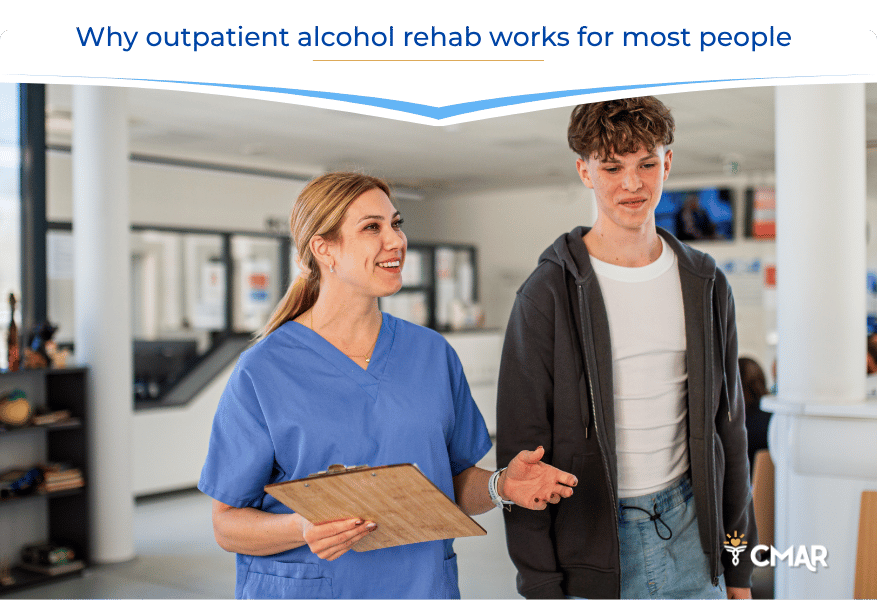
Yes, alcohol rehab without inpatient works, and for most people it works about as well as residential care.
Research shows that outpatient treatment produces comparable outcomes for people who are medically safe to withdraw with monitoring and have a stable place to live. Inpatient is the right answer for a narrower group than most people assume.
If the reason you have not called anyone is that you cannot disappear for a month, this is the part worth reading. That version of rehab is not the only version, and it may not even be the one you need.
Does Outpatient Rehab Actually Work?
This is the fear underneath the question, so it goes first: is outpatient real treatment, or the discount version?
It is real treatment. Research reviewed by NIH concludes that outpatient care is appropriate for most people who have enough social support and no serious co-occurring medical or psychiatric conditions. One randomized trial even found outpatient care led to better abstinence rates than inpatient for the right candidates.
The word doing the work there is “right.” Outcomes are comparable when the level of care matches the person. Outpatient isn’t as good as inpatient for everyone. For most people, it is genuinely the right fit.

Who Fits Alcohol Rehab Without Inpatient
Outpatient works when two things are true at once: you are medically safe to withdraw without a hospital bed, and you have somewhere stable to go home to.
More specifically, you are likely a good outpatient candidate if you have:
- Mild to moderate alcohol use disorder
- No history of severe withdrawal, seizures, or delirium tremens
- A stable, reasonably supportive home environment
- No serious untreated medical or psychiatric condition
- Enough motivation to attend without someone locking the door
That last one matters more than people admit. Outpatient asks you to go home every night to the same environment and choose treatment again the next morning. For a lot of people that is a strength, because they practice recovery in real life instead of in a bubble.
Who Actually Needs Inpatient
Being honest about this is what makes the rest of the article trustworthy. Some people should not start with outpatient.
Inpatient or residential is the safer call when:
- Withdrawal risk is high: heavy daily drinking, past seizures or DTs, or morning drinking to steady the shakes
- There are serious co-occurring medical or psychiatric conditions needing close monitoring
- The home environment actively undermines recovery, with alcohol in the house or people who are not on board
- Repeated outpatient attempts have not held
That first bullet is a safety line, not a preference. Stopping heavy daily drinking without medical supervision can be dangerous, which is why the assessment comes first. We walk through that timeline in how long alcohol detox takes.
The Middle Ground Most People Do Not Know About
Here is what gets lost in the inpatient-versus-outpatient framing: it is not actually a binary. There is a ladder, and most people move down it.
| Level of care | What it looks like | Lives at home? |
| Medical detox | Supervised withdrawal, monitored closely | Sometimes, as outpatient detox |
| PHP (Day Program) | Several hours a day, most weekdays | Yes |
| IOP | A few hours, a few days a week | Yes |
| Standard outpatient | Weekly sessions | Yes |
A lot of people start higher on that ladder and step down as they stabilize. You can get intensive, structured care, sometimes the same clinical hours as a residential program, and still sleep in your own bed. The choice is rarely “a month away” or “nothing.”
What Michael Damioli Looks For
Michael Damioli, LCSW, CSAT, Clinical Director at CMAR, uses the ASAM criteria to make this call, and he is direct about the two dimensions that decide most cases.
The first is medical safety. Can you withdraw with monitoring instead of a bed? The second is your living situation, which carries more weight than people expect. Someone can be a perfect outpatient candidate medically and still not be a fit, because there is alcohol in the kitchen and nobody home who is on board.
The research backs the instinct: outpatient works best for people with social support and a stable environment, and inpatient is reserved for those without them or with serious co-occurring conditions.
If you are not sure which side of that line you fall on, that is exactly what a free assessment answers. Call CMAR at (833) 448-0127 and find out before you assume you need to upend your life.
The Real Advantage of Staying Home
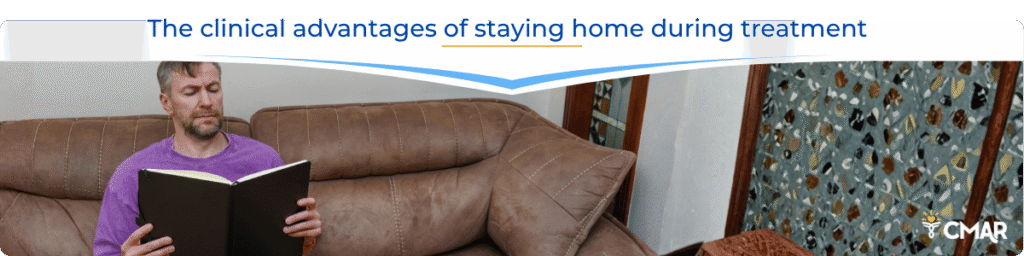
Outpatient is not just the more convenient option. For the right person, staying in your life during treatment is a clinical advantage, not a compromise.
You practice sobriety in the exact environment where you will have to sustain it. You keep your job, your family, and your routine, all of which are assets in recovery rather than things to rebuild afterward. And treatment integrates with real life instead of ending at a discharge date and dropping you back into a world you have not navigated sober in months.
Cost is the other piece. Outpatient is significantly less expensive than residential because you are not paying for a bed and round-the-clock staffing, which also means insurance tends to cover more of it. We cover that in does insurance cover alcohol rehab?
Alcohol Rehab Without Inpatient in Denver
CMAR is built entirely around this model: intensive, structured, medically supported treatment that fits into a life instead of replacing one.
- Outpatient detox with medical oversight, so you withdraw safely without a residential stay
- PHP and IOP with therapy, groups, and medical support, stepping down as you stabilize
- Hybrid in-person and virtual attendance built around work and family
- A free assessment that tells you honestly whether outpatient is safe for you, or whether you need a higher level first
As a CARF-accredited provider of alcohol rehab in Denver, CMAR is in network with most major commercial plans and accepts Colorado Medicaid.
And if you are not sure you need any of this yet, start with do I need rehab for alcohol.
Frequently Asked Questions
For the right candidate, yes. Research shows comparable outcomes when the level of care matches the person. Outpatient suits people with mild to moderate dependence, a stable home, and social support. Inpatient is better for high withdrawal risk or serious co-occurring conditions.
Yes. Many people recover through outpatient programs like PHP and IOP while living at home and working. The key is matching the level of care to your needs. An assessment determines whether outpatient is safe and appropriate for your situation.
Anyone with high withdrawal risk, such as heavy daily drinking, past seizures, or morning drinking, plus people with serious untreated medical or psychiatric conditions or an unstable home environment. Those situations usually need inpatient or a medically supervised higher level of care first.
Yes, significantly. Outpatient does not include housing or 24-hour staffing, which is what drives residential costs up. Insurance also tends to cover more of outpatient care. For many people the lower cost makes sustained treatment realistic rather than a one-time event.
Outpatient fits people who are medically safe to withdraw with monitoring and have a stable place to live. Inpatient is for high withdrawal risk, serious co-occurring conditions, or a home environment that undermines recovery. The assessment sorts this out honestly before anyone starts.