Telehealth Login

|

How to Stop Drinking Alcohol

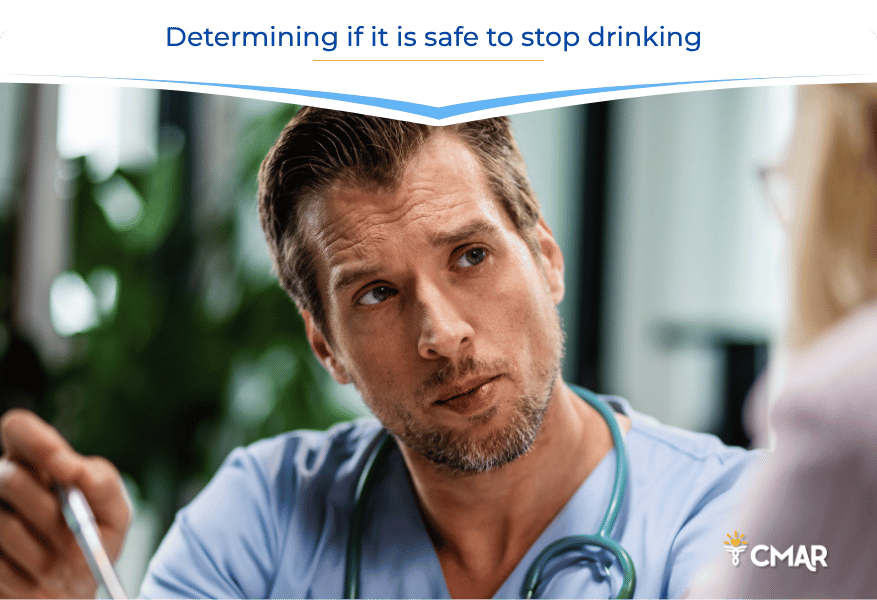
The first step in learning how to stop drinking alcohol is not a plan. It is a safety check. For most people, stopping is uncomfortable but safe. 

For a smaller group who drink heavily every day, stopping suddenly can be dangerous, even life-threatening, and knowing which group you are in changes everything about how you should do this.

You don’t need to have everything figured out to start. In fact, believing you need a perfect plan first is what keeps most people researching for another six months. Here is where to actually begin.
Step 1: Check Whether It Is Safe to Stop

This is the step people skip, and it matters most.

Michael Damioli, LCSW, CSAT, Clinical Director at CMAR, says the most important question isn’t how much you drink. It is whether you drink to relieve withdrawal.

The questions that decide your risk

Ask yourself honestly:

  • Do you drink in the morning to stop shaking, sweating, or nausea?
  • Do you drink heavily every day, and have for a long stretch?
  • Have you ever had a seizure or hallucinations when you cut back?

If any of those are yes, do not stop cold turkey. The NIAAA is clear that abruptly stopping after prolonged heavy drinking can trigger seizures and delirium tremens, which can be fatal without medical care.

That is not a reason to keep drinking. It is a reason to have support in place when you stop, which is what medically supervised detox is for.

If you are lower risk

If you drink moderately, have no morning symptoms, and have never had withdrawal, stopping on your own is generally safe. The rest of this guide is built for you, and it still helps to tell someone what you are doing.

Not sure which group you are in? One phone call answers it. CMAR is at (833) 448-0127, and the assessment is free.

Step 2: Decide Whether to Cut Back or Quit

There are two honest paths, and the right one depends on you.

If this is youThe likely path
Low risk, want to reduce harm, still have controlCutting back, with clear limits
Alcohol is harming your health or relationships, or “one” never stays oneQuitting completely

Damioli’s clinical read is blunt: if you have already tried cutting back with rules, only weekends, only beer, nothing before six, and it keeps not working, that is your answer. When you need a rulebook to manage a substance, the substance is usually already managing you.

There is no shame in that. It is information, and it points toward the path that will actually work.

Step 3: Change Your Environment Before Willpower Is Tested

Willpower loses to a hard Friday night. Setup beats willpower, so do the easy work first.

  • Get the alcohol out of the house, or as much of it as you can
  • Tell one or two people what you are doing, so you are not alone with it
  • Plan for the specific moments you always drink: the 6 p.m. wind-down, the social event, the stressful call
  • Have a non-alcoholic drink ready to reach for
  • Write down why you are doing this, and keep it where you will see it

None of this is dramatic. It just removes the friction that makes drinking automatic.

Step 4: Get Through the First Week

The first week is the hardest, and knowing that in advance helps you not read it as failure.

Expect disrupted sleep, irritability, anxiety, and cravings in the first few days. For lower-risk drinkers, these are uncomfortable but not dangerous, and they ease over the week. If symptoms are severe, that is the signal to get medical help, not to push through alone.

Sleep as much as your body wants, eat regularly even without appetite, drink water, and get through it a day at a time rather than staring at forever.

Step 5: Handle Cravings Without Fighting Them

Here is the thing about a craving: it peaks and fades, usually within 15 to 30 minutes, whether or not you drink. You do not have to defeat it. You have to outlast it.

  • Notice it without panicking. A craving is a wave, not a command
  • Delay. Tell yourself you will decide in 20 minutes, and let the wave pass
  • Change your physical state: walk, shower, call someone, eat something
  • Get curious about what set it off, because triggers repeat and you can plan for the next one

This is also where a medication like naltrexone helps for some people, by quieting the cravings enough that these skills have room to work. Whether it fits you is a conversation with a medical provider.

Step 6: Know When to Bring in Support

Some people stop on their own. Many need more, and needing more is not a failure of willpower. Alcohol is a coping skill, a bad long-term one, and removing it without replacing it is why quitting alone so often does not hold.

Support is a ladder, and you can step onto it wherever you need to:

If you have tried the self-directed version and it has not held, that is not a verdict on you. It usually means the drinking is doing a job that needs to be addressed directly, and that is what treatment is for. Do I need rehab for alcohol can help you tell.

Step 7: Treat a Slip as Data, Not Defeat

If you drink after deciding to stop, that is a lapse, not the end. What determines the outcome is the next 24 hours, not the slip itself.

Get back to your plan immediately. Look at what led up to it, what the trigger was, what you would do differently. People who treat a slip as useful information recover from it. People who treat it as proof they failed tend to spiral. The difference is the story you tell yourself about it.
How CMAR Helps People Stop Drinking in Denver

For a lot of people, the honest answer to “how do I stop” is not a better willpower strategy. It is the right support, matched to their actual risk.

CMAR is built for exactly that:

  • A free assessment that tells you first whether it is safe for you to stop
  • Medically supervised detox so the dangerous part is handled properly
  • PHP and IOP that fit around work and family, not instead of them
  • Medication and therapy together, treating the drinking and the reasons behind it
  • A step-down structure so support decreases as you stabilize

As a CARF-accredited provider of alcohol rehab in Denver, CMAR is in-network with most major commercial plans and accepts Colorado Medicaid. You can verify coverage before deciding anything.

The first step is not a life overhaul. It is a phone call, and it costs you nothing to find out where you actually stand.

Frequently Asked Questions

How do I stop drinking alcohol safely?

Start by checking your withdrawal risk. If you drink heavily daily or have morning symptoms, get medical support before stopping, since withdrawal can be dangerous. If you are lower risk, remove alcohol from your environment, tell someone, plan for triggers, and take it one day at a time.

Is it safe to stop drinking cold turkey?

For light to moderate drinkers, usually yes. For heavy daily drinkers, no. Stopping suddenly after prolonged heavy drinking can cause seizures and delirium tremens, which can be fatal. If you drink to relieve morning shakes, do not quit without medical supervision.

How long does it take to stop drinking?

Physical withdrawal usually eases within a week, but building lasting change takes longer as your brain rebalances and you develop new coping skills. Many people need a few months of support before it feels stable. Recovery is a process, not a single event.

Can I stop drinking on my own, or do I need rehab?

Many people cut back or stop on their own, especially lower-risk drinkers. If you have repeatedly tried and it has not held, or you have withdrawal symptoms, that points toward needing support. An assessment tells you honestly which applies to you.

Where do you start with someone who wants to stop but has no idea how? 

With a phone call, not a plan. People think they need it all figured out first, and that pressure keeps them stuck. The real first step is figuring out whether it is safe to stop, since that shapes everything that follows. Everything else you build together.

Alcohol Rehab Without Inpatient: Does It Actually Work?

Yes, alcohol rehab without inpatient works, and for most people it works about as well as residential care. 

Research shows that outpatient treatment produces comparable outcomes for people who are medically safe to withdraw with monitoring and have a stable place to live. Inpatient is the right answer for a narrower group than most people assume.

If the reason you have not called anyone is that you cannot disappear for a month, this is the part worth reading. That version of rehab is not the only version, and it may not even be the one you need.

Does Outpatient Rehab Actually Work?

This is the fear underneath the question, so it goes first: is outpatient real treatment, or the discount version?

It is real treatment. Research reviewed by NIH concludes that outpatient care is appropriate for most people who have enough social support and no serious co-occurring medical or psychiatric conditions. One randomized trial even found outpatient care led to better abstinence rates than inpatient for the right candidates.

The word doing the work there is “right.” Outcomes are comparable when the level of care matches the person. Outpatient isn’t as good as inpatient for everyone. For most people, it is genuinely the right fit.

inpatient-versus-outpatient-rehab-assessment-cmar

Who Fits Alcohol Rehab Without Inpatient

Outpatient works when two things are true at once: you are medically safe to withdraw without a hospital bed, and you have somewhere stable to go home to.

More specifically, you are likely a good outpatient candidate if you have:

  • Mild to moderate alcohol use disorder
  • No history of severe withdrawal, seizures, or delirium tremens
  • A stable, reasonably supportive home environment
  • No serious untreated medical or psychiatric condition
  • Enough motivation to attend without someone locking the door

That last one matters more than people admit. Outpatient asks you to go home every night to the same environment and choose treatment again the next morning. For a lot of people that is a strength, because they practice recovery in real life instead of in a bubble.

Who Actually Needs Inpatient

Being honest about this is what makes the rest of the article trustworthy. Some people should not start with outpatient.

Inpatient or residential is the safer call when:

  • Withdrawal risk is high: heavy daily drinking, past seizures or DTs, or morning drinking to steady the shakes
  • There are serious co-occurring medical or psychiatric conditions needing close monitoring
  • The home environment actively undermines recovery, with alcohol in the house or people who are not on board
  • Repeated outpatient attempts have not held

That first bullet is a safety line, not a preference. Stopping heavy daily drinking without medical supervision can be dangerous, which is why the assessment comes first. We walk through that timeline in how long alcohol detox takes.

The Middle Ground Most People Do Not Know About

Here is what gets lost in the inpatient-versus-outpatient framing: it is not actually a binary. There is a ladder, and most people move down it.

Level of careWhat it looks likeLives at home?
Medical detoxSupervised withdrawal, monitored closelySometimes, as outpatient detox
PHP (Day Program)Several hours a day, most weekdaysYes
IOPA few hours, a few days a weekYes
Standard outpatientWeekly sessionsYes

A lot of people start higher on that ladder and step down as they stabilize. You can get intensive, structured care, sometimes the same clinical hours as a residential program, and still sleep in your own bed. The choice is rarely “a month away” or “nothing.”

What Michael Damioli Looks For

Michael Damioli, LCSW, CSAT, Clinical Director at CMAR, uses the ASAM criteria to make this call, and he is direct about the two dimensions that decide most cases.

The first is medical safety. Can you withdraw with monitoring instead of a bed? The second is your living situation, which carries more weight than people expect. Someone can be a perfect outpatient candidate medically and still not be a fit, because there is alcohol in the kitchen and nobody home who is on board.

The research backs the instinct: outpatient works best for people with social support and a stable environment, and inpatient is reserved for those without them or with serious co-occurring conditions.

If you are not sure which side of that line you fall on, that is exactly what a free assessment answers. Call CMAR at (833) 448-0127 and find out before you assume you need to upend your life.

The Real Advantage of Staying Home

Outpatient is not just the more convenient option. For the right person, staying in your life during treatment is a clinical advantage, not a compromise.

You practice sobriety in the exact environment where you will have to sustain it. You keep your job, your family, and your routine, all of which are assets in recovery rather than things to rebuild afterward. And treatment integrates with real life instead of ending at a discharge date and dropping you back into a world you have not navigated sober in months.

Cost is the other piece. Outpatient is significantly less expensive than residential because you are not paying for a bed and round-the-clock staffing, which also means insurance tends to cover more of it. We cover that in does insurance cover alcohol rehab?

Alcohol Rehab Without Inpatient in Denver

CMAR is built entirely around this model: intensive, structured, medically supported treatment that fits into a life instead of replacing one.

  • Outpatient detox with medical oversight, so you withdraw safely without a residential stay
  • PHP and IOP with therapy, groups, and medical support, stepping down as you stabilize
  • Hybrid in-person and virtual attendance built around work and family
  • A free assessment that tells you honestly whether outpatient is safe for you, or whether you need a higher level first

As a CARF-accredited provider of alcohol rehab in Denver, CMAR is in network with most major commercial plans and accepts Colorado Medicaid.

And if you are not sure you need any of this yet, start with do I need rehab for alcohol.

Frequently Asked Questions

Does outpatient alcohol rehab work as well as inpatient?

For the right candidate, yes. Research shows comparable outcomes when the level of care matches the person. Outpatient suits people with mild to moderate dependence, a stable home, and social support. Inpatient is better for high withdrawal risk or serious co-occurring conditions.

Can you recover from alcohol without going to inpatient rehab?

Yes. Many people recover through outpatient programs like PHP and IOP while living at home and working. The key is matching the level of care to your needs. An assessment determines whether outpatient is safe and appropriate for your situation.

Who should not do outpatient alcohol rehab?

Anyone with high withdrawal risk, such as heavy daily drinking, past seizures, or morning drinking, plus people with serious untreated medical or psychiatric conditions or an unstable home environment. Those situations usually need inpatient or a medically supervised higher level of care first.

Is outpatient rehab cheaper than inpatient?

Yes, significantly. Outpatient does not include housing or 24-hour staffing, which is what drives residential costs up. Insurance also tends to cover more of outpatient care. For many people the lower cost makes sustained treatment realistic rather than a one-time event.

Who fits outpatient, and who needs inpatient? 

Outpatient fits people who are medically safe to withdraw with monitoring and have a stable place to live. Inpatient is for high withdrawal risk, serious co-occurring conditions, or a home environment that undermines recovery. The assessment sorts this out honestly before anyone starts.

Does Insurance Cover Alcohol Rehab?

Yes. In almost all cases, insurance covers alcohol rehab. Federal law requires most health plans to cover substance use treatment the same way they cover any other medical care, and Colorado Medicaid often covers it at little to no cost. The real question is not whether you are covered. It is what your specific plan covers, and how much you pay out of pocket.

That distinction matters because most people who assume they cannot afford treatment are covered far better than they think. Here is how to find out for certain.

The Short Answer: Almost Always Yes

Two federal laws are the reason.

The Affordable Care Act classifies substance use treatment as an essential health benefit, so ACA-compliant plans have to cover it. And the Mental Health Parity and Addiction Equity Act says a plan cannot put stricter limits on addiction treatment than it does on regular medical care.

In plain terms: if your plan covers a hospital stay for a physical illness, it generally cannot refuse comparable coverage for alcohol treatment.

What “covered” usually includes

  • Medically supervised detox and withdrawal management
  • Outpatient programs like PHP and IOP
  • Individual and group therapy
  • FDA-approved medications for alcohol use disorder
  • Treatment for co-occurring mental health conditions
Does health insurance cover alcohol rehab

What Actually Determines Your Cost

Coverage is close to universal. Plans differ on cost, and it comes down to a handful of numbers.

FactorWhat it means for you
DeductibleWhat you pay before insurance starts covering
Copay or coinsuranceYour share once coverage kicks in
Out-of-pocket maximumThe ceiling, after which the plan covers everything
In vs out of networkIn-network means negotiated rates and a lower share
Level of careOutpatient costs far less than residential

The out-of-pocket maximum detail worth knowing

If detox happens first, some people hit their annual out-of-pocket maximum early in treatment. Once you reach that ceiling, the rest of the year’s care is often covered at or near 100 percent.

So the expensive part can be the front end, and the long stretch of recovery costs less than people expect. It is worth confirming for your own plan.

If You Have Colorado Medicaid

Health First Colorado covers substance use treatment, and for many people that means little to no out-of-pocket cost at all.

The catch is not coverage; it is acceptance: not every facility takes Medicaid. CMAR does, which for a Medicaid-eligible person often removes the cost barrier almost entirely.

If you are not sure whether you qualify, do not assume you are out. People routinely think they earn too much or were denied years ago, and eligibility rules and circumstances both change. An admissions team can check your status quickly instead of leaving you to navigate the state system alone.

The Question People Forget to Ask

When you call to verify, most people ask, “Am I covered?” Michael Damioli, LCSW, CSAT, Clinical Director at CMAR, says that is the wrong first question.

The one people forget is: Is this specific facility in-network, and is this specific level of care authorized?

You can be fully covered for alcohol rehab and still get a surprise bill because the facility was out of network, or because the plan authorized IOP but not the detox you actually needed. Coverage in the abstract is not the same as coverage for the place you are walking into and the care you actually require.

A short script for the verification call

Call the member services number on your card and ask:

  • Is substance use treatment covered under my plan?
  • Is [facility name] in network?
  • Are detox, PHP, and IOP each covered, and is prior authorization required?
  • What is my deductible, and how much of it have I met this year?
  • What is my copay or coinsurance for outpatient treatment?

Write down who you spoke to and when. If a claim gets questioned later, that record matters.

Let the Facility Do This Part

Here is the part that saves people the most stress: you do not have to make that call yourself.

Most treatment centers verify your benefits for you. You hand over your insurance information, and their admissions team decodes the deductible, the network status, the authorizations, and comes back with what you would actually pay, in plain language, before you commit to anything.

At CMAR, you can start that verification online or by phone, and it obligates you to nothing. If you would rather just talk it through, call (833) 448-0127.

How Coverage Works at CMAR in Denver

What If You Are Not Covered, or Underinsured?

Coverage gaps are usually a plan-specific issue, not a dead end, and there are real options:

  • Payment plans that spread the cost over time instead of all at once
  • Sliding-scale or self-pay rates quoted clearly up front
  • Combinations, where insurance covers part and a plan handles the rest
  • Appeals, because a denial or a length-of-stay limit can be challenged under parity law

If cost is what’s been stopping you, that is worth a direct conversation, and we break down what alcohol rehab costs.

How Coverage Works at CMAR in Denver

CMAR is built to answer the cost question early and honestly, not spring it on you later.

  • Free, no-obligation insurance verification before you start
  • In-network with most major commercial plans
  • Colorado Medicaid accepted, often at little to no cost
  • Payment plans and self-pay options where coverage falls short
  • The whole outpatient model built to keep alcohol rehab in Denver within reach of ordinary budgets

As a CARF-accredited outpatient provider, CMAR keeps costs lower than residential care by design, because you are not paying for a bed you do not need.

And if you are still deciding whether treatment is even the right step, do I need rehab for alcohol is a good place to start before the coverage conversation.

Frequently Asked Questions

Does health insurance cover alcohol rehab?

Yes, in almost all cases. Federal parity law and the Affordable Care Act require most plans to cover substance use treatment comparably to other medical care. Your out-of-pocket cost varies and depends on your deductible, network status, and the level of care you need.

Does Medicaid cover alcohol rehab?

Yes. Health First Colorado covers substance use treatment, often at little to no cost for eligible members. The main variable is whether the facility accepts Medicaid, since not all do. CMAR accepts Colorado Medicaid, which removes the cost barrier for many people.

How do I check if my insurance covers rehab?

Call the member services number on your insurance card and ask whether substance use treatment, detox, and outpatient care are covered, and whether the facility is in network. Even easier, let the treatment center verify your benefits, which most do for free.

Will insurance cover the full cost of rehab?

Sometimes, especially with Medicaid or after you meet your out-of-pocket maximum. With commercial plans, you usually owe a deductible and copay. Once you hit your annual out-of-pocket maximum, the plan typically covers the rest of the year at or near 100 percent.

What question do people forget when verifying coverage? 

Whether the specific facility is in-network and whether the exact level of care is authorized. People confirm they are covered in general, then get a surprise bill because the facility was out of network or the plan authorized IOP but not detox. Confirm both.

Do I Need Rehab for Alcohol? How to Know

You might need rehab for alcohol if you have tried to cut back and could not, if drinking is causing problems you keep having to manage, or if you have started drinking in the morning to steady yourself. 

The clearest signal is not how much you drink. It is whether you can reliably stop, and what it costs you when you try.

The fact that you are asking the question at all is worth paying attention to. People who genuinely do not have a problem with alcohol rarely spend an evening searching whether they need rehab.

The Fastest Way to Tell

Forget the amount for a second. The question that cuts through most of the confusion is simpler.

Can you stop when you decide to, and does it stay stopped?

Most people who end up needing help have already run the cutting-back experiment, repeatedly, with rules. Only on weekends. Only beer. Nothing before six. When someone needs a rulebook to manage a substance, the substance is usually already managing them.

The other half of the test is what happens once you start. If the plan is two drinks and it is never two, that is loss of control, and willpower was never the missing ingredient.

The 11 Questions Clinicians Actually Use

There is a real diagnostic tool behind this. The NIAAA uses 11 criteria to identify alcohol use disorder. In the past year, have you:

  • Ended up drinking more, or longer, than you meant to
  • Wanted to cut down or stop, and could not
  • Spent a lot of time drinking or recovering from it
  • Experienced cravings, a strong urge to drink
  • Found drinking interfered with work, home, or school
  • Kept drinking despite it causing relationship problems
  • Given up activities you used to care about in order to drink
  • Gotten into risky situations while or after drinking
  • Kept drinking even though it was worsening a physical or mental health issue
  • Needed more alcohol to get the same effect (tolerance)
  • Had withdrawal symptoms: shakes, sweating, nausea, trouble sleeping

What your number means

  • 2 to 3 yes answers: mild alcohol use disorder
  • 4 to 5: moderate
  • 6 or more: severe

You do not need all 11. Two is enough to meet the clinical threshold, and it is enough to be worth a conversation.

“But I’m Still Functioning”

This objection keeps people out of treatment the longest, and it does not hold up.

Holding down a job is one slice of functioning, usually the last slice to go. Physical health, sleep, relationships, and goals outside work often erode for years while attendance stays perfect. Functioning is not the same as fine.

There is also no rule that you have to lose everything before you deserve help. The earlier you come in, the more of your life is intact, and everything intact- the job, the marriage, the routine- is an asset in getting well rather than wreckage to rebuild.

The One Sign You Should Not Ignore

Some of this is about whether treatment would help. This part is about safety.

If you have started drinking in the morning to stop the shakes or settle how last night left you, that is not a moderation question anymore. That is physical dependence, and it changes everything, because stopping alcohol abruptly when you are physically dependent can be dangerous.

The same applies if you have ever had a withdrawal seizure, or you drink heavily every day. For anyone in that category, the answer is not just “yes, get help.” It is “do not try to stop on your own.” We break down why and how long alcohol detox takes.

If any of that describes you, calling first is the safe move. CMAR is at (833) 448-0127, and an assessment tells you whether stopping needs medical support.

Does Needing Help Mean Inpatient?

No, and this is where a lot of people talk themselves out of getting help.

The image of rehab as a month away from your life keeps people stuck, because that version feels impossible with a job and a family. Most people never need it.

If your situation isThe likely fit
Mild to moderate, stable home, medically safeOutpatient or IOP, often around a work schedule
Moderate to severe, needs daily structure earlyPHP, stepping down over time
Physically dependent, high withdrawal riskMedically supervised detox first, then step down

An assessment matches the level of care to where you actually are, not where you fear you might be. Many people are relieved to learn how much less disruptive it is than they pictured, which is part of what treatment actually involves.

How do I know if I need alcohol rehab

Why Cutting Back Keeps Failing

If you have tried moderating and it keeps not working, that is not a character flaw. It is information.

Alcohol becomes a coping skill. A bad long-term one, but it works in the moment, which is why people lean on it for stress, boredom, sleep, and anxiety. Moderation fails because it only addresses the amount, not the job the drinking is doing.

That is also why treatment works when willpower does not. It replaces the coping skill instead of just removing it, and where a medication like naltrexone fits, it can quiet the cravings enough that the new skills have room to take hold.

Getting an Honest Answer in Denver

The truthful answer to “do I need rehab” does not come from an article. It comes from an assessment, and CMAR’s is free and takes about ten minutes.

  • A real conversation about your drinking, your history, and your goals
  • A clear read on whether you need medical support to stop safely
  • A level-of-care recommendation matched to your life, not a sales pitch
  • Insurance checked in the same call

As a CARF-accredited provider of alcohol rehab in Denver, CMAR is in network with most major commercial plans and accepts Colorado Medicaid. You can verify coverage before deciding anything.

Whatever the answer turns out to be, knowing it beats wondering at 2 a.m.

Frequently Asked Questions

How do I know if I need alcohol rehab?

If you have repeatedly tried to cut back and could not, if drinking is causing problems you keep managing, or if you drink in the morning to feel normal, those are strong signs. Clinically, meeting 2 or more of the 11 DSM-5 criteria for alcohol use disorder indicates treatment would help.

Can I be an alcoholic and still function?

Yes. Many people with alcohol use disorder hold jobs and maintain appearances for years. Work is usually the last area to break down, while health, sleep, and relationships erode quietly beforehand. Functioning does not mean the drinking is not a problem, or that help would not help.

Do I need to go to inpatient rehab for alcohol?

Often no. Many people are treated successfully in outpatient or intensive outpatient programs while living at home and working. Inpatient is reserved for severe cases, high withdrawal risk, or unstable home environments. An assessment determines the right level of care for your situation.

Is it safe to just stop drinking on my own?

Not always. If you drink heavily every day, drink in the morning, or have had withdrawal symptoms like shakes or seizures, stopping suddenly can be dangerous. Those situations need medical supervision. A brief assessment tells you which category you are in.

What tells you someone can’t just cut back on their own?

The number of times they have already tried. Almost everyone who needs help has run the cutting-back experiment repeatedly, with rules like only weekends or only beer. When someone needs a rulebook to manage a substance, the substance is already running things, and willpower is not the missing piece.

Can I Drink While Taking Naltrexone? What to Know

Yes, you can drink alcohol while taking naltrexone, and it will not make you sick the way Antabuse does. But it will feel different. 

Naltrexone blocks most of the pleasure and buzz you normally get from drinking, so alcohol tends to feel flat or pointless. You can still get drunk, still get impaired, and still get hurt. The medication changes the reward, not the intoxication.

That difference is the whole point of how naltrexone works, and it is worth understanding before you decide anything.

What Actually Happens If You Drink on Naltrexone

Nothing dramatic, which surprises people. No flushing, no vomiting, no violent reaction.

Naltrexone is an opioid blocker. When you drink, alcohol normally triggers a release of endorphins that land on opioid receptors and produce the warm, rewarding part of a buzz. Naltrexone sits on those receptors and blocks them, so SAMHSA notes it blunts the effects and feelings of alcohol and reduces how much people drink.

What you will and will not feel

  • Muted reward. The pleasant buzz is largely gone. Most people describe drinking as dull or not worth it
  • Still impaired. Your coordination, judgment, and reaction time are affected exactly as they would be otherwise
  • Still intoxicated. You can still get drunk, and you can still get alcohol poisoning
  • No sickness. Unlike Antabuse, naltrexone does not punish you with nausea

The short version: it does not stop you from getting drunk. It stops drinking from being fun.

Naltrexone Is Not Antabuse

People mix these up constantly, and the difference matters.

NaltrexoneAntabuse (disulfiram)
How it worksBlocks the reward of drinkingMakes you physically ill if you drink
If you drinkFeels flat, no sicknessNausea, vomiting, flushing
The mechanismRemoves the payoffAdds a punishment

Both are real tools, and which one fits which person is a clinical decision. But if you are picturing the medication that makes you sick, that is not this one.

Why the Blunted Buzz Actually Helps

This is where naltrexone does something clever.

When drinking stops delivering a reward, your brain slowly stops chasing it. Over weeks, the craving loop that kept pulling you toward the next drink starts to weaken, because the payoff it was expecting never arrives. Research shows naltrexone reduces the number of heavy drinking days and helps people cut back or stop.

So a slip on naltrexone tends to be shorter and smaller than a slip without it, because the thing the person was chasing is not there to chase. The medication takes the power out of the drink.

So Is It Safe to Drink on It?

Not exactly, and this is where honesty matters more than reassurance.

The real risks

  • Drinking more than you planned. Because the buzz is muted, some people keep drinking trying to feel something and end up drinking more, not less
  • Liver strain. Both alcohol and naltrexone are processed by the liver, so combining them adds load, which matters if your liver is already stressed from drinking
  • Missing the point. Drinking on naltrexone works against the recovery the medication is meant to support

The goal is not “drink safely on naltrexone.” The goal is to use the muted reward as a bridge toward not drinking at all, with support in place while your brain recalibrates.

The One Thing You Must Never Mix

This part is not optional. Naltrexone blocks opioid receptors completely.

If you take opioids while on naltrexone, they will not work, and trying to overpower the block with a larger dose can cause a life-threatening overdose. You must also be fully opioid-free, usually 7 to 14 days, before starting naltrexone, or it can trigger sudden, severe withdrawal.

Tell any provider treating you that you are on it, especially before any surgery or pain treatment.

What This Says About Where You Are

Here is the honest read: if you are asking whether you can drink while on a medication designed to help you stop drinking, part of you is negotiating.

That is not a judgment. It is one of the most human things there is, and it is worth paying attention to rather than pushing away. Naltrexone works best alongside counseling, because the medication handles the chemistry of craving while therapy handles the reasons the drinking started. One without the other leaves half the job undone.

If that negotiation sounds familiar, it is worth talking through with someone who does this every day.

Call CMAR at (833) 448-0127. The conversation is confidential, and it commits you to nothing.

How Naltrexone Fits Treatment at CMAR in Denver

At CMAR, naltrexone is one part of a plan, not the whole plan. It comes as a daily pill or the monthly Vivitrol injection, and the choice depends on you.

As a CARF-accredited provider of alcohol rehab in Denver, CMAR is in-network with most major commercial plans and accepts Colorado Medicaid. You can verify your coverage before deciding anything.

Frequently Asked Questions

Will you get sick if you drink on naltrexone?

No. Naltrexone does not cause nausea or vomiting when you drink. That is Antabuse, a different medication. Naltrexone instead blocks the rewarding, pleasurable effects of alcohol, so drinking tends to feel flat rather than making you physically ill.

Does naltrexone stop you from getting drunk?

No. You can still become intoxicated and impaired, and you can still get alcohol poisoning. Naltrexone blocks the pleasurable buzz and reduces cravings, but it does not reduce alcohol’s effect on coordination, judgment, or reaction time. It changes the reward, not the intoxication.

Can you drink alcohol on the Vivitrol shot?

Yes, the same way as the pill form, since Vivitrol is extended-release naltrexone. Drinking will feel muted rather than rewarding, but you can still get drunk. The injection maintains the effect for about a month, so the blunted-reward experience lasts the whole time.

Is it dangerous to mix naltrexone and alcohol?

It is generally not a dangerous chemical reaction like Antabuse, but there are real risks: drinking more than intended because the buzz is muted, and added strain on the liver, which processes both. It also works against the recovery the medication is meant to support.

What happens if you slip while taking naltrexone?

A slip on naltrexone tends to be shorter and smaller than one without it, because the reward the person is chasing does not arrive. Most people describe it as pointless rather than pleasurable. That blunted response is the medication doing its job, and it is a reason to keep going, not to stop.

Alcohol and Depression: What a CMAR Clinician Wants You to Know

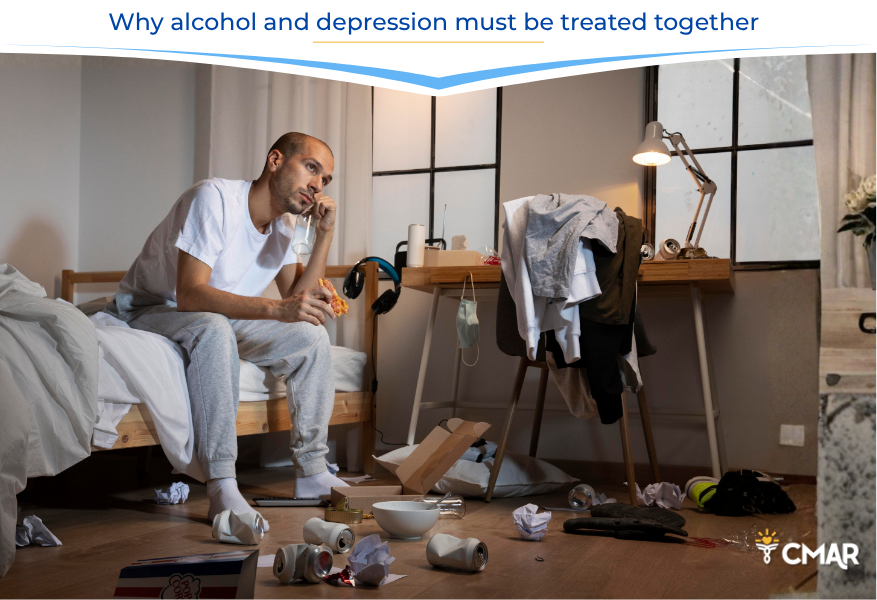
Alcohol and depression feed each other. Alcohol is a depressant, so heavy drinking deepens low mood at a biological level, and depression drives people back to drinking for relief. 
That loop is why “am I depressed because I drink, or do I drink because I’m depressed?” usually cannot be answered from the inside, and why the answer matters less than people think. This article explains why both have to be treated together, what actually happens with antidepressants while someone is still drinking, and how long mood really takes to stabilize.

Michael Damioli has spent his career treating exactly this overlap, where the drinking and the depression are tangled so tightly that neither can be sorted out alone. Here’s how he and the CMAR team approach it.

Which Came First, the Drinking or the Depression? 

Usually nobody knows, including the person living it. Damioli stopped needing that answer before starting treatment a long time ago.

What is certain

Alcohol is a depressant. Drink enough of it for long enough and you will be depressed at a biological level, whatever your mood looked like before. So a large share of the depression that walks through the door was built by the drinking itself.

What runs the other way

Plenty of people had depression, anxiety, or unprocessed trauma first, found that alcohol worked as short-term relief, and used it that way for years before anyone put the word “problem” on it.

The order matters less than people expect because the treatment answer is the same either way. They are two sides of the same coin, and treating one at a time is how you lose to both.

Will the Depression Lift On Its Own If I Stop Drinking? 

Sometimes it genuinely does, and that surprises people.

Take away the depressant, let sleep come back, give the body time to repair, and for a lot of people the mood follows without any other intervention. Because the alcohol was causing so much of it, removing the alcohol resolves a good part of it.

When it does not lift

That is not a failure. It is information, and it is exactly the information the clinical team needs. It tells us there is an independent depression underneath that the drinking was covering, and now it is visible enough to treat properly.

What Damioli will not do is let someone sit sober and miserable while everyone waits to find out. Sober and miserable is not a state people sustain, and it is how relapse happens, not because the person wanted a drink, but because they wanted to stop feeling that way.

If that describes where you are right now, you do not have to wait it out alone.

Call CMAR at (833) 448-0127 and talk it through with someone who treats this every day.

Do You Prescribe Antidepressants While Someone Is Still Drinking? 

This is where a MAT clinic answers differently than a general therapist would, and it is the part people most want a straight answer on.

Damioli is a clinical director, not the prescriber, so this reflects how the team approaches it rather than a script. Generally the medical provider wants to see someone stabilized before starting an antidepressant, for two solid reasons.

The medications work against each other

Alcohol is a central nervous system depressant, and drinking on an antidepressant reduces how well it works. You end up pouring a depressant on top of the medication meant to lift the depression, so nobody can tell whether it is doing anything.

You cannot see the target clearly

While the drinking is active, it is genuinely hard to tell alcohol-built depression from an independent condition. Medicating something you cannot see clearly is not good medicine.

When the team does not wait

This is not a rigid rule. If someone has a long, documented psychiatric history, or the depression is severe enough that safety is the concern, nobody withholds treatment on principle to reach an arbitrary day count. Severity wins that argument.

Why Mixing Alcohol and Antidepressants Backfires 

Even setting aside effectiveness, the combination causes practical problems people rarely anticipate:

  • Worse side effects. Alcohol and most antidepressants share side effects like drowsiness and dizziness, so together they hit harder
  • Skipped doses. Some people skip their medication in order to drink, which destabilizes mood
  • Higher risk. Research links even low-level drinking on antidepressants to reduced effectiveness and increased impulsivity
  • A masked picture. Drinking hides symptoms the provider needs to see to adjust treatment

None of this means the medication was wrong. It means the drinking has to be addressed alongside it, not after it.

How Long Until Mood Stabilizes? 

Longer than people want to hear, and getting that expectation right is half the work.

StageWhat is happening
First week or twoWithdrawal and rebound. Nothing here is your real baseline
Next several weeksThe brain recalibrating. Sleep normalizing, emotions coming back online, mood swinging
Around 90 daysThe real picture emerges. Mood either lifts, or an underlying condition shows itself clearly

This is why Damioli asks for a real commitment to treatment. You cannot measure your actual baseline two weeks after your last drink.

A lot of people feel worse before better, because emotions flattened for years come back all at once, and they need to hear that in advance or they read it as proof that sobriety is not for them. It is also the window where, as Damioli puts it, the lights come on: someone walks in one day and something has visibly shifted in how they meet the world.

Where Medication for Drinking Fits In 

CMAR is a medication-assisted treatment clinic, so there is another lever here that a talk-therapy-only setting does not have.

A medication like naltrexone quiets alcohol cravings while the antidepressant question gets sorted out. That matters, because it gives someone room to stay stopped long enough for their real baseline to appear, instead of relapsing in the fragile early window.

The medication for drinking and the treatment for the mood are not competing. They address the same problem from two angles. If you want the details on that side, we cover whether you can drink on naltrexone separately.

Can alcohol cause depression

How CMAR Treats Alcohol and Depression Together in Denver 

Because the two are so tangled, treating them separately does not work. CMAR is built to treat both at once.

  • Integrated care where a therapist treats the depression while the drinking is addressed, in one coordinated plan
  • Medical assessment for antidepressants and for MAT, timed to when they will actually help
  • Medically supervised detox first when someone needs help getting alcohol-free safely
  • Structure through PHP and IOP, so support decreases as the picture clarifies

As a CARF-accredited provider of alcohol rehab in Denver, CMAR is in network with most major commercial plans and accepts Colorado Medicaid. You can verify coverage before deciding anything.

Ask a Clinician: Michael Damioli on Alcohol and Depression

Which comes first, the drinking or the depression?

“Usually nobody can tell you, including the patient, and I stopped needing that answer before starting treatment. What I know for certain is alcohol is a depressant. Drink enough for long enough and you’ll be depressed at a biological level. The other direction is just as real. But the order matters less than people think, because the answer’s the same either way. You treat both together.”

Do you prescribe antidepressants while someone’s still drinking?

“Our medical provider makes that call, but generally we want someone stabilized first. Alcohol works against most antidepressants, so if you’re still drinking, nobody can tell if the medication’s doing anything. Unless it’s severe or there’s a long psychiatric history, we wait for real information.”

So what does CMAR actually do for someone caught in this?

“We treat both at once, which is the whole point. Our outpatient program pairs a therapist working the depression with medical care working the drinking, and if naltrexone fits, it holds the cravings down while the rest of it takes hold. One plan, one team, instead of two providers who never talk to each other. That’s what our alcohol program in Denver is built around.”

Frequently Asked Questions

Can alcohol cause depression?

Yes. Alcohol is a central nervous system depressant, so heavy or prolonged drinking can produce depression even in someone with no prior history. It also wrecks sleep, which worsens mood. For many people, depression improves once drinking stops and the brain recovers.

Should I stop drinking before starting antidepressants?

Usually yes. Alcohol reduces how well antidepressants work and makes it hard to tell if the medication is helping. Most providers want a person stabilized first, though severe depression can change that. It is decided with a medical provider, not alone.

Is it safe to drink on antidepressants?

It is generally discouraged. Alcohol intensifies side effects like drowsiness, worsens depression, and reduces the medication’s effectiveness. It rarely causes an acute dangerous reaction with common SSRIs, but it undermines the treatment, which defeats the purpose of taking them.

How long after quitting drinking does depression improve?

Often within a few weeks to a few months. The first week or two is withdrawal, not a real baseline. Mood typically stabilizes around 90 days as the brain recovers. If it persists beyond that, it likely needs its own treatment alongside recovery.

Does treating them together actually work better?

Yes. You cannot measure a real baseline two weeks after the last drink, so CMAR treats the drinking and the depression at once and gives it about 90 days before judging the mood. Treating one at a time is how people lose to both.

How Long Does Alcohol Detox Take?

Alcohol detox usually takes 5 to 10 days. Symptoms typically start within 6 to 24 hours of your last drink, peak between 24 and 72 hours, and taper off over the following week.

That is the average. How long alcohol detox takes for you depends on how much you drank, for how long, how often, and what else is in your system. A decade of daily heavy drinking is a longer process than eight hard months.

The peak window is the part that matters medically, and it is the reason detoxing under supervision is safer than doing it alone.

The Alcohol Detox Timeline

WhenWhat is happening
6 to 24 hoursFirst symptoms. Anxiety, sweating, nausea, shaky hands, trouble sleeping, rising heart rate
24 to 72 hoursThe peak. Symptoms at their strongest. Highest risk of seizures, and where delirium tremens can appear
Days 3 to 5Things start easing. Sleep still poor, mood still rough, but the medical risk drops
Days 5 to 10Most physical symptoms resolve. Energy begins returning
Weeks 2 to 8Post-acute symptoms. Sleep disruption, mood swings, and cravings that come and go in waves

That last row catches people off guard. The detox itself is over in about a week, but feeling like yourself again takes longer, because the brain is still rebalancing.

Why the peak window matters

Between 24 and 72 hours is when withdrawal seizures are most likely, and when delirium tremens can develop in people with severe dependence. DTs involve confusion, hallucinations, fever, and dangerous swings in heart rate and blood pressure.

It is not common, but it is serious enough to affect how the whole process is managed.

What Makes Detox Shorter or Longer

Five things move the timeline more than anything else:

  • How much you drink. Heavier daily intake means a longer taper
  • How long you have been drinking. Years of dependence take more time to unwind than months
  • Whether other substances are involved. Benzodiazepines in particular stretch detox considerably
  • Your age and liver function. Both affect how quickly your body clears alcohol and stabilizes
  • Previous withdrawals. Each time someone goes through withdrawal, the next one can be more severe

That last point is called kindling, and it is the reason repeated attempts at quitting cold turkey are not neutral. They can raise the stakes.

Why nobody should quote you a number over the phone

Michael Damioli, LCSW, CSAT, Clinical Director at CMAR, is blunt about this:

“People build their week around whatever number they’re told. If we haven’t assessed somebody, that number is a guess.”

The assessment takes about ten to fifteen minutes, and it is free. You can start it here or call (833) 448-0127 and get an actual answer instead of a range from a website.

Detoxing at Home vs With Medical Support

Some people can taper safely at home. Many cannot, and alcohol is one of the few substances where getting that wrong has real consequences.

Signs you should not detox alone

  • You drink in the morning to steady yourself or stop the shakes
  • You have had a withdrawal seizure or DTs before
  • You drink heavily every day and have for a long stretch
  • You are also using benzodiazepines
  • You have significant medical conditions, particularly heart or liver

Any of those means medical supervision, not willpower.
What supervised detox actually involves

At CMAR, outpatient alcohol detox means you sleep at home while a medical team manages the process. You come in for monitoring, and comfort medications handle symptoms while your nervous system settles.

How often you come in depends on your risk. Higher risk means daily. Steady vitals and a stable home mean less frequent visits. Which medications are used and why is decided by a medical provider after the assessment.

If symptoms escalate past what outpatient can safely handle, you get moved to a higher level of care and the program arranges it.

What Happens After Detox

Detox is not treatment. It is what makes treatment possible.

Five to ten days clears the alcohol. It does nothing about the reasons the drinking started, which is why the week after detox is where a lot of people lose ground.

Most people step into PHP or IOP from there, where therapy and group work begin, and any depression or anxiety underneath gets treated rather than waited out. If you want the full picture of that sequence, we walk through it in what happens in alcohol rehab.

Anyone comparing alcohol rehab in Denver should ask what that handoff looks like before they commit. A detox with nothing behind it rarely holds.

Getting Through Detox in Denver

CMAR runs medically supervised outpatient detox, which means you are monitored properly without leaving your life for a week.

  • Free assessment that tells you your actual timeline, not an average
  • Comfort medications during the peak window, tapered on a plan
  • Monitoring frequency matched to your real risk
  • A direct step into therapy and groups when detox ends

CMAR is CARF-accredited, in-network with most major commercial plans, and accepts Colorado Medicaid. You can check your coverage before making any decisions.

For the full program, start with alcohol rehab in Denver.

Frequently Asked Questions

How long do alcohol withdrawal symptoms last?

Physical symptoms usually resolve within 5 to 10 days, with peak symptoms occurring between 24 and 72 hours. Post-acute symptoms such as poor sleep, mood swings, and cravings can continue in waves for several weeks afterward as the brain rebalances.

What is the worst day of alcohol detox?

Usually day 2 or day 3. That is when symptoms peak and when seizure and delirium tremens risk is highest. It is also when people are most likely to drink again to make it stop, which is why supervision matters most during that specific window.

Can you die from alcohol withdrawal?

Yes, though it is uncommon. Delirium tremens carries a meaningful mortality risk without treatment, and withdrawal seizures can be dangerous. Anyone with heavy daily drinking, morning drinking, or a history of severe withdrawal should not stop without medical supervision.

How long until you feel normal after detox?

Physical symptoms clear in about a week, but most people need one to three months before mood, sleep, and energy stabilize. That gap is normal and is not a sign treatment is failing. It reflects how long the brain takes to recover.

What determines whether detox is three days or ten?

How much, how long, how often, and what else is in your system. Ten years of daily heavy drinking is a different taper than eight hard months. Benzodiazepines stretch it considerably, and age and liver function both matter, which is why an assessment comes before any timeline.

What Happens in Alcohol Rehab?

Alcohol rehab starts with an assessment, moves through withdrawal if you need medical support for it, then settles into a routine of group sessions, individual therapy, and regular check-ins with a medical provider. At an outpatient program you go home every night, and many people keep working the whole time.

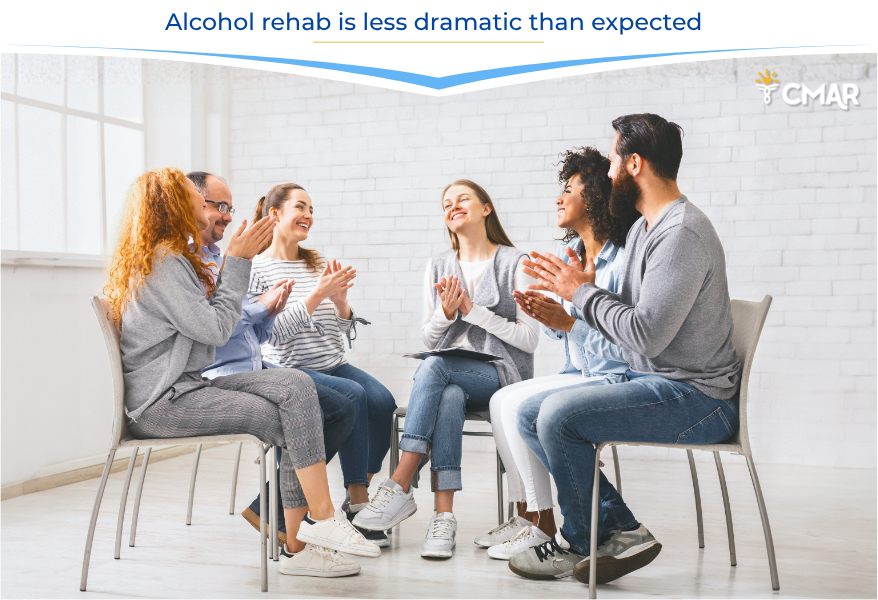
What happens in alcohol rehab is a lot less dramatic than most people picture. 

There is no shouting, no confiscated belongings, no stranger reading your diary aloud. Mostly, it is the conversation, the structure, and the people who have heard your version of this before.

Here is what the process actually looks like, step by step.

Step 1: The First Phone Call

This is an assessment, not an interrogation.

Someone asks what you drink, how much, how often, when you started drinking each day, whether you have tried stopping before, what happened when you did, and what your home life looks like. It takes about ten to fifteen minutes.

What they are actually figuring out

Two things: whether it is medically safe for you to stop, and which level of care fits.

That first one is not a formality. Alcohol is one of the few substances where stopping abruptly can be dangerous, so the timing question matters more than the quantity question. Somebody who drinks in the morning to steady themselves is in a different category from somebody who drinks heavily on weekends.

You can start that conversation without committing to anything. Insurance is checked on the same call, so you are not guessing about the cost while you decide.

Step 2: Withdrawal, If You Need Support For It

Not everyone does. But if you do, this is the part people fear most and understand least.

At CMAR, outpatient detox means you sleep at home while a medical team manages the withdrawal. You come in for monitoring, get comfort medications to handle symptoms, and the frequency of those visits depends on your risk.

How long it takes

Symptoms usually start within 6 to 24 hours of your last drink, peak somewhere between 24 and 72 hours, and ease over roughly a week.

Ten years of daily heavy drinking is a longer taper than eight hard months. Benzodiazepines in the mix stretch it. Age and liver function matter. This is exactly why nobody should quote you a number before an assessment.

If the withdrawal escalates beyond what outpatient can safely handle, you get moved to a higher level of care and the program arranges it. That is the system working, not a failure.

Step 3: The Actual Treatment

Detox is not rehab. Detox is what makes rehab possible.

Getting the alcohol out of your system takes days. Changing the reasons you drink takes considerably longer, and that is where the real work lies.

A typical week

Most people start in one of two levels:

Level What it looks like Who it fits
PHP Several hours a day, most days of the week Coming out of detox, or needing serious structure early on
IOP Three-hour sessions, three days a week Working around a job and family, or stepping down from PHP

Inside those hours: group sessions, individual therapy, and check-ins with your medical provider if medication is part of your plan.

What group is actually like

This is the part people dread most and end up valuing most.

Group is not confession. It is a room of people at various stages of the same problem, talking about what happened this week and what they did about it. Some days, it is practical, like figuring out how to get through a wedding. Some days somebody has a hard week, and the room holds it.

What surprises people is how ordinary it feels after the third or fourth session.

Step 4: Treating What Is Underneath

Alcohol is a coping skill. A bad long-term one, but it works, which is why people lean on it.

Take it away, and you are left facing stress, grief, boredom, and anxiety with nothing in your hands. That is why individual therapy runs alongside the groups, and why any co-occurring depression or anxiety gets treated at the same time rather than after.

Waiting to see whether the depression lifts on its own leaves people sober and miserable, and that is not a state anyone holds for long.

Where medication fits

For some people, a medication like naltrexone quiets cravings enough that they can actually practice the new skills instead of white-knuckling through every evening.

It is not required, and it is not for everyone. The medications used and who they suit is a conversation with a medical provider, not a decision you make in advance.

Step 5: Stepping Down, Not Dropping Off

Programs end. The risk is what happens the week after.

Good programs step you down gradually: PHP into IOP, IOP into weekly outpatient, and then into whatever community you have built. CMAR calls this transition to continued care, and it is worth asking any program you call how they handle it.

A detox with nothing behind it is where a lot of people lose the progress they just made.

What Michael Damioli Says Surprises People Most

“Nobody yells at them. I’m being half serious. People show up braced for something punitive, some version of what they’ve seen on television, and instead it’s an assessment, a plan, and a room where nobody is judging them.”

The second surprise is logistical. Most people assume they are about to vanish from their life for a month. Then they go home that evening, and most of them are still working.

What Alcohol Rehab Looks Like at CMAR in Denver

CMAR is outpatient, which means the whole model is built around treatment fitting into a life rather than replacing one.

  • Assessment and insurance check on the first call
  • Medically supervised withdrawal with monitoring matched to your risk
  • PHP and IOP with therapy, groups, and medical support
  • Mental health treated alongside the drinking
  • A structured step-down rather than a hard stop

If you are comparing options for alcohol rehab in Denver, the questions worth asking are what the handoff after detox looks like, whether mental health is treated in the same plan, and how the step-down is structured.

CMAR is CARF accredited, in-network with most major commercial plans, and accepts Colorado Medicaid. You can verify coverage before making any decisions, or call (833) 448-0127 to ask what your situation would actually involve.

For the full picture of the program, start with alcohol rehab in Denver.

Frequently Asked Questions

How long does alcohol rehab last?

It depends on the level of care. Detox is usually days. PHP often runs a few weeks, IOP commonly around 8 to 12 weeks, and outpatient continues after that. Most clinicians ask for at least 90 days of engagement, because that is roughly how long the brain needs to stabilize.

Do you have to detox before rehab?

Only if you are physically dependent. Many people go straight into treatment without needing medical withdrawal support. An assessment determines which applies to you, based on how much you drink, how often, and whether you have symptoms in the morning.

Can you work during alcohol rehab?

Often yes, particularly in IOP, which is designed around work and family schedules. PHP is harder to combine with full-time work because of the hours. Many people start in PHP briefly, then step down to IOP and return to their normal schedule.

What do you do all day in rehab?

Group sessions, individual therapy, and medical check-ins if medication is part of your plan. Groups cover coping skills, triggers, relapse prevention, and processing what came up that week. Outpatient programs run in blocks of hours rather than filling the entire day.

What actually surprises people most about rehab? 

How ordinary it feels. People arrive expecting something punitive and find an assessment, a plan, and a room where nobody is judging them. The other surprise is that they go home each evening and most keep working, rather than disappearing from their lives for a month.

Alcohol Withdrawal and Medication: What a CMAR Clinician Wants You to Know

Alcohol is one of the few substances where quitting on your own can be dangerous. Not uncomfortable. Dangerous. That is why alcohol withdrawal and medication get discussed together so often, and why the first question is never which pill; it is whether you are safe to stop at all.

In this article, Michael Damioli, LCSW, CSAT, Clinical Director at Colorado Medication Assisted Recovery, explains what CMAR actually prescribes, how the team decides who needs daily monitoring, what happens if withdrawal worsens, and why the medication question is usually a shame question in a costume.

If you are trying to work out whether you can just stop drinking this weekend, start here.

Alcohol Withdrawal and Medication: Two Kinds, and People Mix Them Up

This is the confusion Damioli untangles most often, so it goes first.

Getting through withdrawal

During the withdrawal window itself, the medical team uses comfort medications to keep you safe and functional while your nervous system settles. Blood pressure, tremor, sleep, anxiety, seizure risk.

This part is short. It tapers down over days, and the end date is written into the plan before you start.

Staying stopped afterward

That is a separate conversation, and it usually happens once the first part is behind you. There are three FDA-approved options for alcohol use disorder, and they do genuinely different jobs.

Medication What it does Who it tends to fit
Naltrexone Quiets cravings and blocks most of the reward of drinking. Daily pill or monthly injection People whose main obstacle is craving, or who know they will not take a daily pill
Antabuse Makes you physically ill if you drink People who want a hard wall between themselves and the decision
Acamprosate Helps steady brain chemistry after you have stopped People who have stopped and are managing ongoing discomfort

None of this is decided before an assessment; our medical provider makes that call, not a website.

“Most people arrive assuming medication means one pill forever. That’s almost never what it turns out to be.”

Can You Safely Stop Drinking on Your Own?

Some people can. But alcohol withdrawal can cause seizures and delirium tremens, and the NIAAA is clear that severe withdrawal is a medical event, not a rough weekend.

The question Damioli asks first

Not how much you drink. When.

If you are drinking in the morning to stop the shakes or fix what last night did to you, that is not a habit anymore. That is physical dependence, and that person should not be stopping alone.

The same conversation applies if there has been a seizure before, or DTs, or years of heavy daily drinking.

Who is usually lower risk?

Someone who drinks hard on weekends and wakes up rough but steady is a different clinical picture. Not risk-free, but different.

Here is the honest problem with that distinction: everybody reading this assumes they are the second category. That is human, and it is also the one part of this where guessing wrong has real consequences.

A free assessment takes about ten minutes on the phone and answers it properly. Call CMAR at (833) 448-0127 and ask before you decide anything.

How CMAR Decides Who Needs Daily Monitoring

CMAR uses ASAM criteria, six dimensions that sound more clinical than they are:

    • Withdrawal risk based on your history and your last drink

    • What is happening medically

    • What is happening emotionally

    • Where your readiness actually sits

    • What happened in previous attempts

    • Your living situation

The dimension that decides more cases than people expect

That last one.

Damioli has had patients who were textbook candidates medically and still were not a fit, because there was alcohol in the kitchen and a partner at home who did not think any of this was necessary. The medication does its job, and the environment undoes it every night.

What the schedule actually looks like

Daily visits are for the higher-risk end. Significant withdrawal history, medical complications, a home situation that will not help.

Less frequent visits work for people whose vitals are holding and who have somewhere safe to sleep.

And it is not locked in. We start somewhere, watch how you respond, and adjust. Responding well means spacing it out. Struggling means tightening it up.

What Happens If Withdrawal Gets Worse?

This is the question Damioli thinks people should ask every program they call, because the answer tells you whether they are being straight with you.

The monitoring is the point

Vitals, symptoms, how you slept, what your hands do when you hold them out. That is what the visit schedule is for.

If symptoms climb faster than expected, the first move is adjusting medication. If they keep climbing, we move you up a level of care, and that can mean medically supervised detox at a higher intensity. We arrange it. You are not making phone calls in that condition.

That is not a failed attempt

Moving up a level is the system doing exactly what it was built to do.

“The scenario I’m trying to prevent is somebody at home at 2 a.m. deciding on their own whether what they’re feeling is normal. At that hour, alone, nobody makes that call correctly.”

If you are somewhere in that window right now, or you are watching someone who is, that is a reason to call tonight rather than in the morning.

“Isn’t This Just Trading One Dependency for Another?”

Damioli hears this constantly, and he thinks it usually comes from a decent instinct that has landed on the wrong target.

Dependence and addiction are not the same thing

A diabetic is dependent on insulin. Nobody says they are addicted to it.

There is a real difference between a drug that is wrecking your family, your job, and your health, and a medication that is helping you function inside your life.

With withdrawal medication, it is days

Not years. It is a taper, and it ends.

With naltrexone, the question falls apart

There is nothing there to get hooked on. Naltrexone is a blocker. No high, no euphoria, no withdrawal when you stop taking it, no street value, not a controlled substance.

According to SAMHSA, it reduces cravings and blocks the effects of alcohol, which is the opposite of what a substance of abuse does. We covered how that plays out month to month in Vivitrol for alcohol use disorder.

The part underneath the question

Damioli puts this carefully because it can land the wrong way.

Most of the time, this question is not really about pharmacology. Shame is the single biggest thing keeping people out of treatment, and “I should be able to do this myself” is one of the ways it shows up wearing reasonable clothes.

Nobody asks a person with pneumonia to fight it off on principle.

What Comes After Withdrawal

Getting through the first week is not treatment. It is the thing that makes treatment possible.

The medication quiets the chemistry. It does nothing about the 6 p.m. trigger, the stress, the relationships, or the reason drinking became the answer to every feeling you have.

That is why what happens after detox matters as much as the detox itself. At CMAR that usually means stepping into PHP or IOP, where the therapy and group work happen, and where any co-occurring depression or anxiety gets treated rather than waited out.

Anyone comparing alcohol rehab in Denver should ask what that handoff looks like, because a detox with no plan behind it is where a lot of people lose the progress they just made.

How CMAR Handles Alcohol Withdrawal in Denver

CMAR runs outpatient detox with medical oversight, which means you sleep at home while a medical team manages the withdrawal.

    • Assessment before anything is prescribed, by a medical provider, not an intake script

    • Monitoring frequency matched to your actual risk, adjusted as you go

    • Comfort medications during the withdrawal window, tapered on a plan

    • A conversation about maintenance medication once you are through it

    • A direct handoff into therapy and groups, because the medication is one half

As a CARF-accredited provider of alcohol rehab in Denver, CMAR is in-network with most major commercial plans and accepts Colorado Medicaid.

You can verify your coverage before you commit to anything.

Ask a Clinician: Michael Damioli on Withdrawal and Medication

Is it safe to stop drinking on your own?

“Some people can. But alcohol is one of the few things where stopping on your own can genuinely kill you, and I say that plainly because the alternative is people finding out at home on a Tuesday night. The first thing I ask isn’t how much somebody drinks. It’s when. If you’re drinking in the morning to stop the shakes, that’s physical dependence, and that person shouldn’t be doing this alone.”

How do you decide who comes in daily?

“Six things, and the one that decides the most cases is the living situation. I’ve had patients who were textbook candidates medically and still weren’t a fit, because there was alcohol in the kitchen and a partner at home who didn’t think any of this was necessary. The medication does its job, and then the environment undoes it every night.”

What if withdrawal gets worse mid-program?

“We’re watching for exactly that. Vitals, symptoms, how you slept, what your hands are doing when you hold them out. If it climbs, we adjust the medication first. If it keeps climbing, we move you up a level, and we arrange it. That’s not a failure of outpatient. That’s the system working.”

Is medication just trading one dependency for another?

“A diabetic is dependent on insulin. Nobody says they’re addicted to it. There’s a difference between a drug that’s wrecking your family and a medication that’s helping you function. And with naltrexone, there’s nothing there to get hooked on at all. It’s a blocker. No high, no withdrawal, no street value.”

Frequently Asked Questions

What medications are used for alcohol withdrawal?

Comfort medications during withdrawal manage symptoms like tremor, blood pressure, anxiety, and seizure risk, and they taper over days. Separately, three FDA-approved medications support staying stopped: naltrexone, Antabuse, and acamprosate. Which ones fit you is decided by a medical provider after an assessment.

How long does alcohol withdrawal last?

Symptoms usually begin within 6 to 24 hours of the last drink, peak between 24 and 72 hours, and ease over roughly a week. The peak window carries the highest medical risk. Post-acute symptoms like sleep disruption and mood swings can continue for weeks afterward.

Can you detox from alcohol at home?

Some people can with medical supervision, which is what outpatient detox provides. Stopping entirely alone is risky if you drink daily, drink in the morning, or have had seizures or DTs before. An assessment determines which category you are in, and it is free.

Is naltrexone addictive?

No. Naltrexone is an opioid blocker, not an activator. It produces no high, no euphoria, and no withdrawal when stopped, and it is not a controlled substance. It reduces cravings and blocks the rewarding effects of alcohol, which is the opposite of how a substance of abuse works.

Do you have to be sober before starting medication?

For naltrexone, yes. You generally need to be alcohol-free for about a week and fully opioid-free before starting. That gap is exactly what CMAR’s outpatient detox is designed to bridge, with medical supervision instead of willpower carrying you through it.

Vivitrol for Alcohol Use Disorder: What a CMAR Prescriber Wants You to Know

Vivitrol is a once-monthly injection of naltrexone that reduces alcohol cravings and blocks much of the reward drinking produces. It is not addictive; it does not make you sick if you drink, and it is one of the most evidence-backed medications for alcohol use disorder.

It is also widely misunderstood, which is why so many people spend months researching it without ever making a call.

In this article, Michael Damioli, MSW, CSAT, Chief Clinical Officer at Colorado Medication Assisted Recovery, walks through what he wants every patient to know before the first appointment: who Vivitrol is for, what the first injection involves, and what the first 30 days feel like.

If you are comparing treatment options for drinking right now, this is the conversation you would have if you called us.

What Is Vivitrol and How Does It Work for Alcohol?

Vivitrol is the extended-release, injectable form of naltrexone. One shot from a medical provider lasts about four weeks, which removes the daily decision of whether to take a pill.

Naltrexone is an opioid blocker. That sounds strange for an alcohol medication until you know how drinking works in the brain: alcohol triggers a release of natural endorphins, and those endorphins land on opioid receptors to produce the warm, rewarding part of being buzzed. Vivitrol sits on those receptors and blocks them. According to SAMHSA, the result is reduced craving and reduced reward, which is exactly the combination that helps people stop.

What Vivitrol doesWhat Vivitrol does not do
Reduces alcohol cravingsDoes not make you sick if you drink (that is Antabuse)
Blocks most of the euphoric reward of drinkingDoes not prevent intoxication or impairment
If a relapse happens, tends to shorten it and reduce how much is drunkDoes not create dependence, a high, or abuse potential
One shot covers about four weeksDoes not work as a standalone cure without counseling

That third row on the left is the part Damioli highlights most with patients. In his words, if somebody does relapse on Vivitrol, the drinking tends to be shorter and lighter, because the payoff is not there, and people come back to treatment sooner. The medication does not just help prevent the slip. It shrinks the slip.

The evidence backs the approach: in the clinical trial behind Vivitrol’s FDA approval, patients receiving Vivitrol with counseling had 25 percent fewer heavy drinking days per month than patients receiving placebo with counseling.

Who Is a Good Candidate for Vivitrol?

In our assessments, the patients who tend to do well share a few things:

  • They have decided they want to stop or seriously reduce drinking, and cravings are the thing sabotaging that decision
  • They can get through a short alcohol-free window before the first shot
  • They prefer a monthly appointment over remembering a daily pill, or they know from experience that they stop taking daily medications
  • They are willing to pair the medication with counseling, because the shot handles cravings, not the reasons behind the drinking

There are two hard medical requirements. First, you need to stop drinking before starting: the FDA approved Vivitrol for people who are alcohol-free at the start of treatment, typically about a week.

If you are still drinking daily, that window can feel impossible, and this is where CMAR is different from a standalone Vivitrol clinic: our outpatient detox program can manage alcohol withdrawal medically, with daily monitoring and comfort medications tapered over several days, so the path from drinking to first injection is supervised rather than white-knuckled. If you are wondering what that gap looks like, we break down the timeline in how long does alcohol withdrawal last.

Second, you must be fully opioid-free, usually 7 to 14 days, including painkillers. Because Vivitrol blocks opioid receptors, starting it with opioids in your system triggers immediate, severe withdrawal. This is screened carefully at intake.

One more caution from the transcript of our clinical conversations: anyone with existing liver damage needs clearance from their liver specialist first, since naltrexone is processed by the liver. Outside of that, Damioli is direct: most people tolerate Vivitrol very well, and we encourage most patients with alcohol use disorder to at least consider it, following an assessment with our medical provider.

Wondering whether you would clear those requirements? That is a ten-minute phone conversation, not a research project. Call CMAR at (833) 448-0127 and ask. No commitment comes with the question.

Is Vivitrol Just Trading One Drug for Another?

This is the concern Damioli hears most, and his answer starts with a distinction: dependence is not addiction.

“A diabetic is dependent on insulin, but nobody says they’re addicted to it. There’s a difference between a drug that’s causing issues in your life and a medication that’s helping you be more functional in your life.” Michael Damioli, MSW, CSAT

With Vivitrol the concern dissolves even further, because there is nothing to trade to. Naltrexone is a blocker, not an activator. It produces no high, no euphoria, no withdrawal when you stop, and no street value. It is not a controlled substance. You cannot become addicted to a medication whose entire job is to keep receptors quiet.

You can become a person whose cravings no longer run the schedule. That is the trade.

What Happens the Day of the First Injection?

Patients are often surprised by how ordinary the first day is. At CMAR, it looks like this:

  • Intake and assessment. You meet our medical provider for a full assessment and physical workup, including your drinking history, medications, and liver health. Labs are drawn if needed.
  • Opioid screening. We confirm you are opioid-free before the shot is cleared, because safety here is non-negotiable.
  • The injection itself. Vivitrol is a single intramuscular shot in the upper buttock, given by our medical team. It takes a few minutes.
  • The plan for the month. Before you leave, your counseling and group schedule is set, because the medication is one half of the treatment, not the whole of it.

Soreness at the injection site for a few days is the most common complaint. Some people have nausea or stomach upset in the first days, which typically settles. You come back in about four weeks for the next shot, and our team checks in well before then.

What Do the First 30 Days Feel Like?

For most people: quieter. The background noise of craving turns down, sometimes dramatically, and the evening hours stop being a negotiation.

Some patients describe the first few weeks as flat, like nothing is quite as enjoyable. Damioli takes that seriously rather than waving it off. Part of it can be the medication settling in, and part of it is early recovery itself: a brain that has leaned on alcohol for reward needs time to remember how to generate its own. Either way, it is usually temporary; it is worth telling your provider about, and it is exactly the stretch where group support carries people, because everyone in the room has felt some version of it.

The first 30 days are also where counseling stops being a formality. Vivitrol handles the chemistry of craving. It does nothing about the stress, the habits, the 6 p.m. trigger, or the relationships around the drinking. That is what the therapy is for, and it is why the manufacturer itself states the medication must be paired with a recovery program to work.

If the flat stretch, the trigger hours, or the first month in general is what worries you, that is a good sign you are taking this seriously. Talk it through with our team before you decide anything: (833) 448-0127, or start with our Vivitrol program page.

What Does Success Look Like at 90 Days?

Not just a sobriety streak. Abstinence, or a major reduction in drinking, is the first indicator we look for, but Damioli calls it the simple one. The markers that tell us Vivitrol and treatment are actually working are broader:

  • Fewer and weaker cravings, and less mental energy spent fighting them
  • Better sleep, better physical health, more energy
  • Relationships at home improving
  • Showing up more consistently at work
  • Engagement with the recovery community, in whatever form fits

There is a moment Damioli describes seeing over and over, where the lights come on for somebody: they walk in one day and you can tell something changed in how they meet the world. Recovery takes time, the brain takes time to heal, and new habits take time to form.

But when the cravings are chemically quieted while that healing happens, people get to that moment more often, and sooner.

CMAR Builds Treatment Around Vivitrol in Denver

How CMAR Builds Treatment Around Vivitrol in Denver

Colorado Medication Assisted Recovery is built on a simple position: medication and therapy are two sides of the same coin, and using both increases your odds. As a dedicated provider of medication-assisted treatment in Denver, we combine:

  • Medical care: assessment, the monthly Vivitrol injection, and outpatient detox when you need medical support to get alcohol-free before starting
  • Therapy and groups: structure, accountability, and support, the core of how we treat, with individual counseling addressing what drives the drinking
  • Practical help: insurance verification on the first call, and case management for the real-life barriers that derail treatment

Most people researching Vivitrol have already decided something needs to change. The medication question is really a fit question, and fit is determined in an assessment, not a search bar.

Ask a Clinician: Michael Damioli on Vivitrol for Alcohol

When someone comes in interested in Vivitrol, what do you want them to know before they walk in the door?

“That it’s appropriate for most people. Most people tolerate it very well and have minimal side effects, such as some GI distress in the first few days. The main exceptions are anybody currently on opioids, and anybody with existing liver damage, who needs to work with their hepatologist first. Outside of those situations, we really encourage most people to consider it, following an assessment with our medical provider.”

How do you answer someone who says Vivitrol is just replacing one addiction with another?

“I explain the difference between dependence and addiction. A diabetic is dependent on insulin, but that doesn’t mean they’re addicted to it. There’s a difference between a drug that’s causing issues with your family and your life, and a medication that’s helping you be more functional in your life. And with Vivitrol specifically, there’s no high in it at all. There’s nothing there to be addicted to.”

What actually makes it work for alcohol?

“It reduces cravings, and if somebody does have a relapse, it reduces the amount they drink and how long they drink, because it blocks a lot of the euphoric experience they’re looking for. So people come back to treatment and back to recovery sooner. It takes the power out of the slip.”

What does the treatment around the shot look like at CMAR?

“The medication is one pathway, and we want people using as many pathways as possible, because that’s what increases the odds. So at CMAR, Vivitrol sits inside the full program: our medical provider handles the injection and monitoring, outpatient detox gets someone safely alcohol-free first if they need it, and our counseling and groups do the work the medication can’t, the coping skills, the triggers, the life around the drinking. Medication and treatment are two sides of the same coin. We don’t hand out one side.”

Frequently Asked Questions

What happens if you drink on Vivitrol?

You will not get sick, and you can still become impaired, but most of the pleasurable reward of drinking is blocked. Many people find drinking simply feels pointless. Continued heavy drinking on Vivitrol is a signal to adjust the treatment plan, and it adds strain on the liver, so tell your provider.

How long do you have to be sober before the Vivitrol shot?

For alcohol, you should be alcohol-free when treatment starts, typically about a week. You must also be fully opioid-free, usually 7 to 14 days, or the shot can trigger severe withdrawal. CMAR’s outpatient detox can bridge that window with medical supervision instead of willpower.

How long does one Vivitrol shot last?

About four weeks. The extended-release injection maintains a steady level of naltrexone throughout the month, and then you return for the next shot. That monthly rhythm is the main advantage over daily naltrexone pills, which only work on the days you remember and choose to take them.

Is Vivitrol addictive?

No. Naltrexone is an opioid blocker, not an activator. It produces no euphoria, no high, and no withdrawal when stopped, and it is not a controlled substance. It carries none of the trade-offs people worry about with other medications used in addiction treatment.

Does Vivitrol make everything feel flat?

Some patients describe the first weeks as emotionally muted. Part of that can be the medication, and part is early recovery itself, as the brain relearns to produce reward without alcohol. It is usually temporary and worth reporting to your provider; it is also one reason group support matters most in the first month.

VERIFY INSURANCE

Cortland Mathers-Suter

MSSA
Managing Partner

Cortland Mathers-Suter entered the treatment space after his own battle with addiction. He first worked as a peer mentor, before starting clinical work while completing his Masters of Science in social administration from Case Western Reserve University where he focused on policy and direct practice. Cortland moved to Colorado in 2015 to start his first addiction treatment program, AspenRidge Recovery. Under his tenure, AspenRidge Recovery became a two-location, nationally accredited organization. He has since spent the last two years researching and developing what is now Colorado Medication Assisted Recovery (CMAR).

According to Cortland, “Colorado Medication Assisted Recovery is the most important organization I have had the honor to help build. We’re offering a service that seeks to not only improve the lives of our patients but also evolve how we look at medication-assisted treatment in Colorado entirely. Most individuals receiving medication-assisted care only receive medication and urinalysis. Sure you can call that ‘treatment,’ but you can’t call that ‘recovery.’ Our model is about adding the missing recovery component, and thus affords an opportunity to achieve lasting change for each patient and the industry.”

Cortland and his treatment programs have received numerous honors. These include Colorado Business Magazine’s “GenXYZ” award, the 2020 “Titan 100” award, and his program AspenRidge Recovery was both a finalist for “Best Healthcare Company” and named in the “Company’s to Watch” by Colorado Business Magazine as well. He has been interviewed and quoted by numerous publications for his “addiction expertise”, including News Week, 5280 Magazine, the Denver Post, Elephant Journal, Colorado Biz Mag, and TheRecoverySource.org.

Tyler Whitman

Compliance/HR Administrator

Tyler is originally from Omaha, Nebraska. He worked in manufacturing administration for 18 years until he chose to pursue recovery from alcohol addiction, which led him to Chicago, Illinois. Since then, Tyler gained experience in retail, retail pharmacy, and healthcare as a vaccine coordinator for a local Colorado clinic. At the clinic, Tyler discovered that healthcare was the career change he had been looking for. His newfound passion for healthcare, combined with his lived experience with addiction, brought him to Colorado Medication Assisted Recovery as an Office Administrator.

In his free time, Tyler enjoys cooking, hiking, and skiing. He is currently pursuing a master’s degree in Health Services Administration from Regis University.

Simmeren Boanvala

BA
Outreach and Admissions Representative

Simmeren comes to CMAR after several years working admissions in inpatient psychiatry and addiction. A first-generation Colorado Native, Simmeren attended CU Boulder, where she earned a BA in psychology. Simmeren is currently completing her CAC III while working toward her master’s degree in marriage and family therapy.

According to Simmeren, “I joined CMAR because I believe in the quality and importance of the program whole-heartedly. My goal at CMAR is to guide each prospect who calls CMAR to find the best possible pathway to their recovery”. Simmeren currently lives in her hometown with her dog and cat.

Tyler Hale

Tyler Hale

Community Partnership Lead

Tyler Hale began his career in addiction treatment following a decades-long fight with his own substance abuse issues. Since achieving long-term recovery, Tyler has held various positions in direct care, client services, admissions and outreach departments at various addiction treatment organizations. From sober living program director to outreach director to admissions director at a drug and alcohol treatment program, Tyler consistently finds himself in leadership roles within the addiction treatment space.

Tyler is originally from Chicago, IL, where he graduated from Loyola University Chicago with a Bachelor of Arts in Sociology and Bioethics. Thereafter, Tyler built a successful career in the tech industry, before finding sobriety and a subsequent calling to help others. Tyler joined the team at CMAR because he believes in the efficacy of comprehensive and patient-centered outpatient treatment. In his free time Tyler enjoys camping, hiking and spending time with his newborn son.

Kirstin O’Carroll

MSW
Engagement and Relations Director

Kirstin O’Carroll started her career in addiction and mental health services 23 years ago after graduating with an MSW from The Oho State University. Hired directly from an internship program, she served as a case manager and vocational specialist on a community treatment team in Columbus, OH, working to help severely mentally ill adults remain at home and in a community setting. Within the same organization, she later transitioned to clinical assessment and crisis intervention services with children, adolescents, and adults. Through these experiences, she learned the importance of providing empathetic, high-quality care and the need to “start wherever the patient is” with regard to finding the best treatment & solutions for her patients.

After seven years, Kirstin made a career change to diagnostic sales and worked for several Fortune 500 companies as an acute care sales specialist. She is delighted to return “home” to her passion for helping others and believes her new role as community engagement coordinator for CMAR is the perfect alignment of both her clinical and sales skills. When not promoting CMAR, she can be found reading, running, hiking, watching movies, and spending time with her husband Dennis and senior canine son Reggie.

Thomas Mazzarella

LAC
Primary Therapist

Thomas is a Licensed Addiction Counselor (LAC) in the State of Colorado and a Licensed Addictions Specialist (LCAS) in the State of North Carolina with particular expertise in the treatment of chronic Substance Abuse Addiction and Dependency.

Thomas is dedicated to Individual, Couples, Family, and Group Counseling and Therapy for individuals with Substance Use and Mental Health issues and concerns.

James Jackman

CAS
Primary Therapist

James Jackman is a Certified Addiction Specialist and has been practicing addiction treatment in Colorado since 2015. James is pursuing his bachelor’s degree in psychology from Metropolitan State University Denver. James is a traditional CBT therapist specializing in childhood events that lead to adult addictions.

James has received special training in Family Systems, Inner Child, Maladaptive Schemas, and Adverse Childhood Experiences. James has worked in many treatment settings throughout his career and uses a client-centered treatment approach to help one recover from destructive patterns that facilitate addiction. In addition, James enjoys working with rescue animals and advocates for several local rescue organizations outside of work.

Megan Hanekom

LPC, LAC, NCC
Therapist & Clinical Compliance Officer

Megan is a licensed counselor who has worked in various mental health and addiction treatment environments. She practices cognitive behavioral therapy and motivational interviewing and believes in pulling from various therapeutic approaches to best support each individual. Megan received her bachelor’s in psychology and Spanish from Concordia College. She relocated from North Dakota to Colorado where she earned a master’s in counseling psychology from the University of Denver.

Outside of the office, Megan enjoys spending time with her two German Shepherds and her cat. She is passionate about fostering animals through various local rescues to find adoptive homes for dogs and cats in need.

Maggie Coyle

MA, LPC
Primary Therapist

Maggie Coyle, MS, MA, LPP, LPCC has worked in the mental health and addictions counseling field for the past six years. She has extensive experience in working in the varying levels of mental health and addictions treatment as well as with diverse populations.

She practices cognitive-behavioral therapy and dialectical behavior therapy as primary intervention methods. She has earned a bachelor’s degree in sociology as well as a master’s degree in clinical mental health counseling both from Northern State University in Aberdeen, SD. She has also earned a master’s degree in addictions counseling from the University of South Dakota in Vermillion, SD. Maggie moved from South Dakota to Colorado in June 2020 and is excited to be a part of the CMAR team.

Michael Damioli

LCSW, CSAT
Clinical Director

Michael Damioli has been passionately working in the fields of addiction treatment and mental health since 2012. He has held a variety of different roles within the addiction recovery space, ranging from peer support to direct clinical practice. Notably, Michael was part of a leadership group that developed a small therapy practice into a nationally branded addiction treatment program, which offers multiple levels of care to recovering professionals. Michael is a strong believer in the family disease model of addiction and has focused much of his clinical work and training on supporting families impacted by addiction. He also specializes in treating individuals suffering from co-occurring chemical and process addictions.

Michael is honored to be leading the clinical care team at CMAR and believes that excellent clinical care begins by simply treating a patient with dignity and respect. Michael is a strong advocate for ethical reform within the addiction treatment field and is excited to promote CMAR as an ethical and thought leader throughout the treatment & recovery industry. Michael earned his master’s degree in social work from the University of Denver and is independently licensed as a clinical social worker with the state of Colorado. He holds an advanced post-graduate certificate in marriage and family therapy from the Denver Family Institute as well as an advanced certificate in sexual addiction counseling from the International Institute of Trauma and Addiction Professionals.

Dwight-Duncan

Dwight Duncan

Psy.D
Psychologist

Dr. Duncan was born and spent most of his early life in California. He received his doctorate in clinical psychology from the University of Denver in 1987. He is a licensed psychologist as well as a licensed addiction counselor. He has had extensive training and experience throughout his professional career in medical psychology, mindfulness, integrated behavioral healthcare, and substance abuse.

Dr. Duncan is married and has one daughter, a neurologic physical therapist in Los Angeles.

Susan-Miget

Susan Miget

NP
Medical Provider

Susan has been in healthcare for more than 20 years. She was an ICU nurse for nine years, then returned to school and completed her master of nursing and family nurse practitioner degree at the University of Missouri-St. Louis in 2007. She practiced pain management for many years before developing her current passion for addiction treatment.

Susan has transitioned her practice to focus entirely on addiction treatment. She has worked in residential treatment, partial hospitalization (PHP), and intensive outpatient (IOP) programs. Susan most enjoys working with patients one-on-one in a private office to protect their confidentiality and ensure top-rate care. Knowing that addiction can affect anyone, anywhere, and at any time, Susan continues to strive to make treatment more accessible and confidential.

Whitney-Grant

Whitney Grant

MSN, FNP-BC, ARNP, RN, CPN
Medical Provider

Whitney Grant is an experienced family nurse practitioner with experience and expertise in medication-assisted treatment. Whitney earned her BSN at the University of Miami before moving on to achieve a master of science in nursing degree there as well, becoming a nurse practitioner immediately thereafter.

Whitney has since achieved board certification from the ANCC as a family nurse practitioner. After spending her entire formative and educational years in South Florida, Whitney moved to Denver in 2018 to pursue a career as a provider in family practice, sub-specializing in addictions medicine. Whitney has worked under the guidance of Dr. Nathaniel Moore, CMAR’s medical director, since moving to Denver.

Nathaniel Moore

MD
Medical Director

Dr. Nathan Moore is board-certified by the American Board of Family Medicine. Dr. Moore attended Stanford University in Palo Alto, CA for his undergraduate work and then attended Duke University School of Medicine and obtained his M.D. in 1995. Dr. Moore then came to Colorado and completed his residency in family medicine at the University of Colorado’s Family Medicine Program at Rose Medical Center.

Dr. Moore practices primarily at our Aurora location. He provides comprehensive family medicine services and has a special interest in addiction medicine, treating patients with opioid use disorder as well as alcohol addiction.

Dr. Moore is married with three children. He enjoys mountain biking, running, and golf.