Telehealth Login

|

Is Medication Assisted Treatment Just Trading One Addiction for Another?
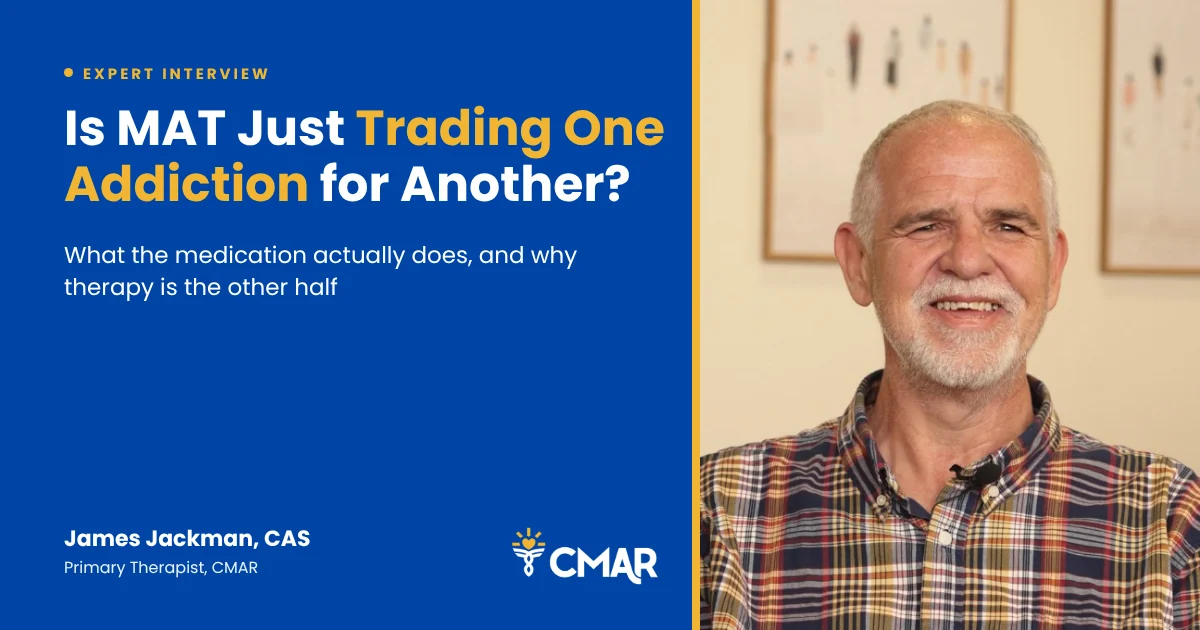
Is Medication Assisted Treatment Just Trading One Addiction for Another?

Straight answers from our addiction specialist on what MAT medication does, how it differs from addiction and why therapy is the other half.
November 5, 2026
 
7 min read
MAT
Addiction Recovery
Suboxone
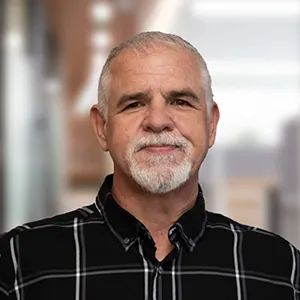
In conversation with
CAS, Primary Therapist @ Colorado Medication Assisted Recovery
A Certified Addiction Specialist practicing in Colorado since 2015, James focuses on helping people recover a part of themselves they lost through addiction.
Trading one addiction for another

No. Medication assisted treatment is not trading one addiction for another, even though it’s the worry people bring to CMAR more than any other. Addiction is compulsive use that keeps causing harm.

MAT uses an FDA-approved medication at a steady, prescribed dose to calm cravings and withdrawal, so a person can function and do the work of recovery. At CMAR, the medication is always one part of a plan that includes therapy.

Key takeaways

  • MAT is not trading one addiction for another. Addiction is compulsive use despite harm; MAT is a steady, prescribed dose.
  • Physical dependence on a prescribed medication is not the same thing as addiction.
  • Each MAT medication does a specific job, from easing withdrawal to blocking a drug’s effects.
  • At CMAR, medication always comes with therapy, groups and case management.

James is a Certified Addiction Specialist who has worked in addiction treatment in Colorado since 2015. We asked him the question patients bring to their first visit.

Where the Fear of Trading One Addiction for Another Comes From

Most people who ask have a reason. Maybe you spent years watching someone you love chase the next pill or the next drink. So when a doctor says “a medication every day,” your stomach drops. A film each morning? A shot each month? It can sound like a new habit with a prescription.

James starts with the brain. During substance use, he says, “there are so many things happening in the brain and so many changes that are created.”

Medication is there to settle those changes down. It isn’t there to restart the cycle that caused them:

  • Addiction: use you can’t control, that keeps causing problems and takes over more of your life.
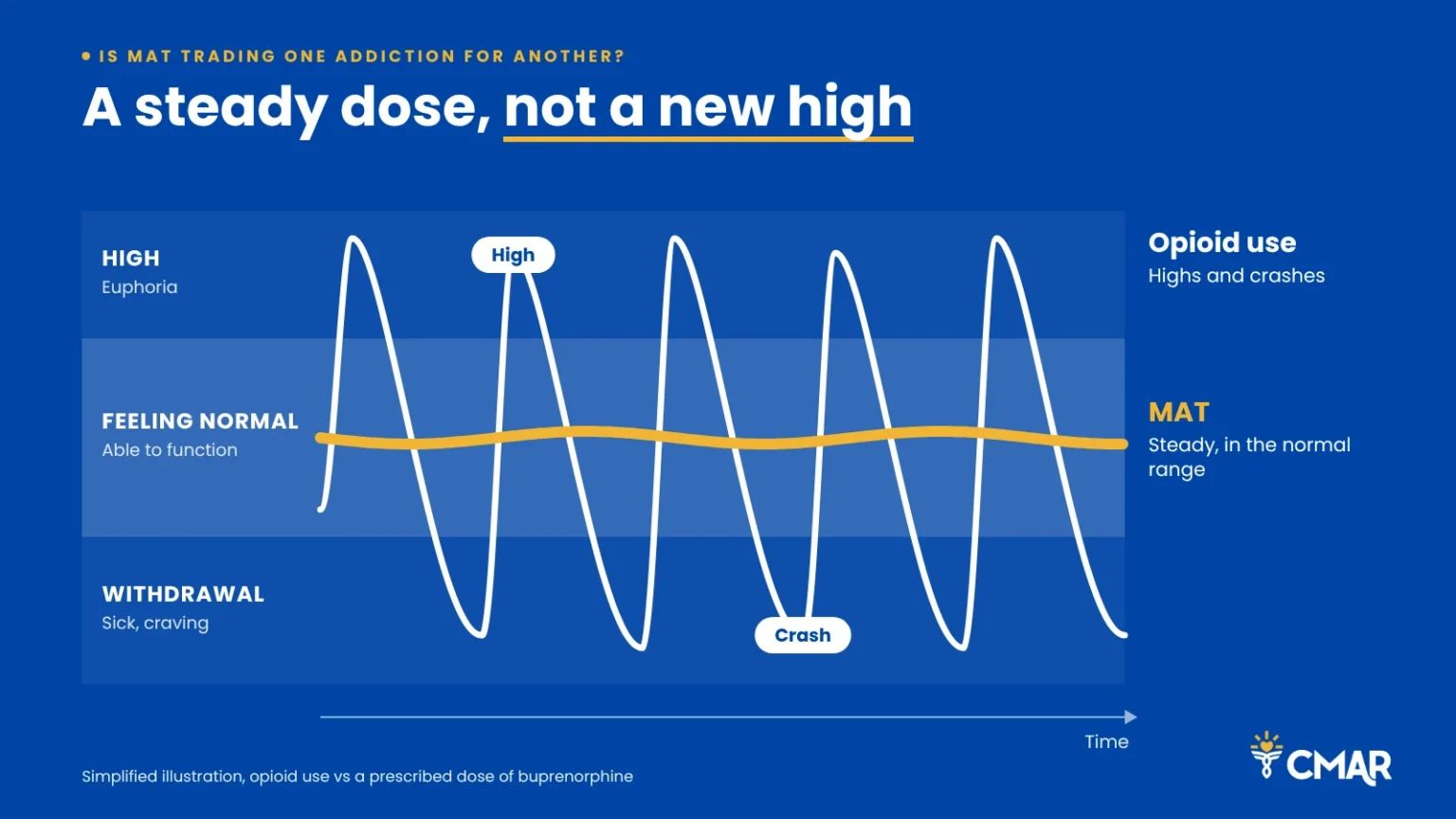
  • MAT: a prescribed dose, taken the same way every time and managed by a medical provider, so the rest of your life can come back.

Dependence vs. Addiction: Why They Aren't the Same

Dependence and addiction are different things, and someone taking MAT as prescribed can have the first without the second. Mixing them up is what makes MAT sound like a swap, so it helps to see how clinicians define each one:

Physical dependence is the body getting used to a medication. Stop it suddenly and withdrawal follows. It happens with plenty of medicines taken exactly as prescribed, including pain medication after surgery.

Addiction, diagnosed today as a substance use disorder, is a pattern of use that causes real impairment or distress, with loss of control at its center.

Researchers from the National Institute on Drug Abuse note that people often confuse the two, and that the difference matters when choosing treatment (Journal of Clinical Investigation, 2020). The same logic answers whether buprenorphine creates a psychological dependency when it’s taken as prescribed.
Is MAT trading one addiction for another

What MAT Medication Actually Does

Think of MAT medication as taking the body off emergency mode. One medication eases withdrawal, another quiets cravings, another blocks a drug’s effects. Once that settles, a person can actually show up for therapy, for groups and for the rest of recovery. In James’s words:

“Medication-assisted treatment really goes a long way to help stabilize the person and minimize the effects of post-acute withdrawal syndrome.”
James Jackman

Post-acute withdrawal is the stretch after detox when cravings, poor sleep, low mood and irritability can linger for weeks or longer (SAMHSA, Protracted Withdrawal, 2010). It’s one of the main reasons people return to a substance after deciding to stop.

Each medication CMAR uses does a different job:

MedicationUsed forWhat it does
Suboxone, Subutex, Sublocade (buprenorphine)Opioid use disorderEases withdrawal and cravings; its effects level off at moderate doses
Vivitrol (naltrexone)Alcohol and opioid use disorderBlocks the effects of opioids and lowers alcohol cravings
Antabuse (disulfiram)Alcohol use disorderMakes drinking cause an unpleasant reaction

Mechanisms are summarized from SAMHSA TIP 63, the Vivitrol prescribing information and the disulfiram label on DailyMed. A CMAR medical provider decides which one fits, as part of how MAT works at CMAR.

The Medication Is One Piece of the Puzzle

At CMAR, medication is never the whole treatment. It handles cravings and withdrawal so they stop running the day. The deeper work happens in therapy, where people deal with stress, old patterns and the habits that grew up around using. James puts it simply:

“The medication-assisted therapy part of it is just a piece of the puzzle. It's not the whole solution.”
James Jackman

That’s how CMAR is built. Medication comes alongside individual therapy, group work, DBT and case management in our PHP Program and 3-Day IOP.

Worried that MAT will only swap one problem for another? Ask us on your first call. It’s the question we hear most, and the answer becomes part of your plan. See how getting started at CMAR works.

What Changes Once Cravings and Withdrawal Are Under Control

When cravings and withdrawal ease up, people get their attention back. Mornings stop being about the next craving, and suddenly there’s room for therapy and for the rest of life. Of everything that changes, James points to one shift above the rest:

“The biggest change is the ability to do the emotional work... the ability to show up.”
James Jackman

The most rewarding change, he says, is watching a patient learn, sometimes for the first time in their life, “what it looks like to develop self-love and a positive self-regard.”

The changes he sees most often:

  • More stability in day-to-day life
  • Fewer cravings pulling at attention
  • Room to take part in life again

Medication Assisted Treatment in Denver at CMAR

If the fear of trading one addiction for another has kept you from calling, it isn’t a reason to wait. CMAR treats alcohol and opioid use disorder through MAT for alcohol in Denver and MAT for opioids, with comfort medications and medication for alcohol withdrawal when detox comes first.

Your first visit covers your history, your goals and which medication, if any, fits, and our team can verify your insurance benefits before you come in.
Medication assisted treatment in Denver

That fear is part of a wider stigma around MAT that keeps people from care that works. If you want to stop drinking, the next question is usually Vivitrol vs Antabuse. Learn more about medication assisted treatment in Denver, or call CMAR in Denver at (833) 448-0127.

Get started
→

Frequently Asked Questions

No. Suboxone’s main ingredient, buprenorphine, is taken at one steady dose, and past a moderate dose its effects stop climbing. It eases withdrawal and cravings so you can get on with your day, and the naloxone in it discourages misuse. Your body may grow dependent on it. Taken as prescribed, that’s treatment, not addiction.

SAMHSA defines recovery as a process of change in which people improve their health and wellness, live self-directed lives and work toward their full potential (SAMHSA). Taking a prescribed medication as directed fits within that. The medication isn’t used to get high; it’s used to stay stable while life moves forward.

There’s no set end date. Some people take an MAT medication for months, others for years, and the right length depends on your health, your progress and your goals. What matters is that any change is planned. Never stop a medication on your own; your CMAR provider adjusts or tapers it with you.

No. Vivitrol contains naltrexone, an opioid blocker, and its label notes it isn’t associated with developing tolerance or dependence. It’s given as an injection by a healthcare provider about once a month to reduce drinking or prevent a return to opioids. Because it blocks opioids, your provider will talk with you about pain medication.

Most people with alcohol or opioid use disorder who have struggled to get time away from the substance are good candidates, James says. CMAR also uses comfort medications that help with withdrawal from virtually any substance. A CMAR medical provider reviews your history and health before recommending any medication.
Steve Sarin headshot
Marketing Director
A certified recovery coach who has written extensively about recovery and substance use disorder, Steve leads the expert interviews behind CMAR's articles.
In conversation with
CAS, Primary Therapist @ Colorado Medication Assisted Recovery
A Certified Addiction Specialist practicing in Colorado since 2015, James focuses on helping people recover a part of themselves they lost through addiction.
Worried MAT is just a swap?

Medication-Assisted Treatment: Your Questions Answered

Medication-Assisted Treatment: Your Questions Answered

Straight answers from a CMAR addiction specialist on how MAT works, which medication fits and what it costs.
October 6, 2026
 
7 min read
Medication Assisted Treatment
Naltrexone
Suboxone
In conversation with
CAS, Primary Therapist @ Colorado Medication Assisted Recovery
A Certified Addiction Specialist practicing in Colorado since 2015, James focuses on helping people recover a part of themselves they lost through addiction.
James Jackman, CAS, Primary Therapist at CMAR, beside the group room at CMAR and the title Medication-Assisted Treatment: Your Questions Answered

The short answers

  • MAT pairs an FDA-approved medication with therapy. The medication steadies you so the therapy can work.
  • At CMAR it treats alcohol and opioid use disorder, with Vivitrol, Suboxone, Sublocade and Antabuse among the options.
  • Colorado Medicaid and most major insurance plans cover MAT at CMAR, and we check your benefits first.

If you are thinking about medication-assisted treatment, you probably want to know how it works, which medication fits, whether it is safe long term and what insurance covers.

James Jackman, CAS, a Certified Addiction Specialist and Primary Therapist at CMAR who has worked in addiction treatment in Colorado since 2015, answers the questions we hear most.

q

What Is Medication-Assisted Treatment?

Medication-assisted treatment (MAT) is the use of an FDA-approved medication together with therapy to treat alcohol or opioid use disorder. The medication eases withdrawal and cravings, and the therapy does the deeper work, so a person can focus on recovery instead of just getting through the day.

In James’s words, MAT helps “stabilize the person and minimize the effects of post-acute withdrawal syndrome,” the lingering cravings, poor sleep and low mood that can follow detox. Our medication-assisted treatment in Denver leans on the therapy side on purpose.

q

What Does a MAT Program Include?

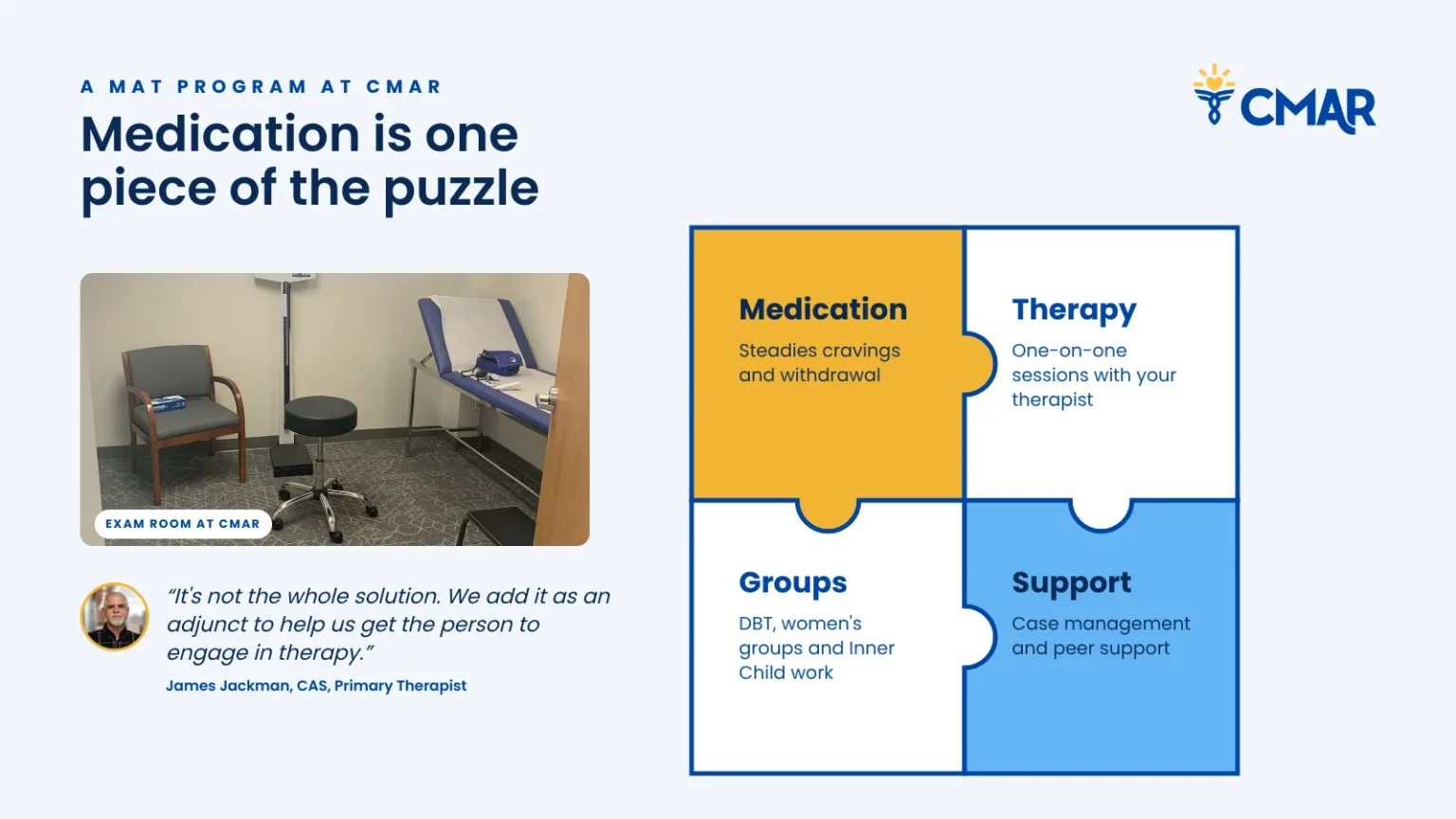
A MAT program includes a medical assessment, a prescribed medication and ongoing therapy. At CMAR it also includes group work, case management and peer support in an outpatient setting, so the medication is never the only thing doing the work.

The four pieces of a MAT program at CMAR: medication, therapy, groups and case management with peer support

Some clinics hand out the medication with little else. We build the therapy in because, as James puts it, the medication is “just a piece of the puzzle.” Groups include DBT, women’s groups and Inner Child work, and MAT can run alongside our PHP Program or 3-Day IOP.

q

What Medications Are Used in MAT?

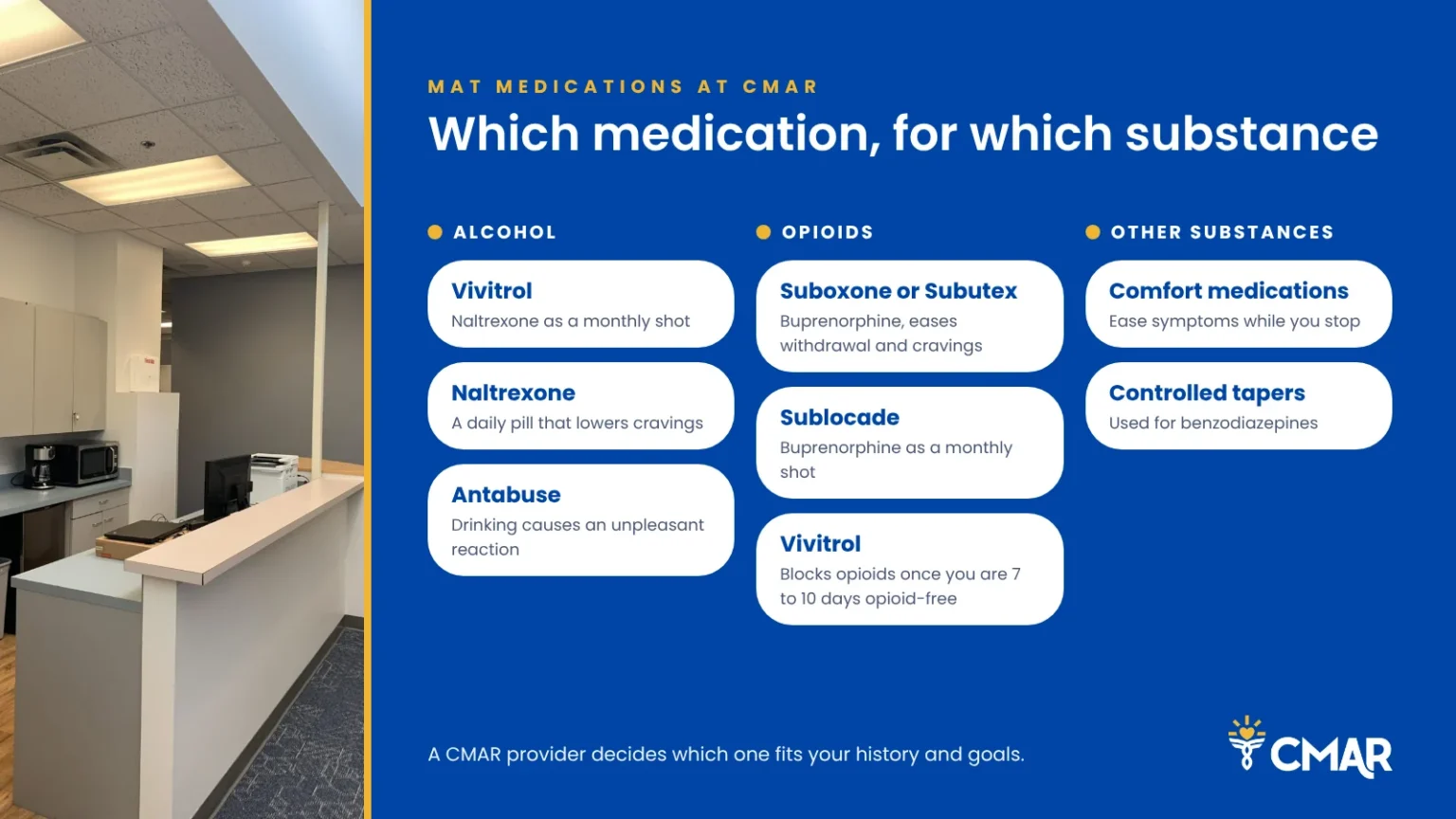
The main MAT medications are buprenorphine (Suboxone, Subutex, Sublocade) for opioid use disorder, naltrexone (a daily pill or the monthly Vivitrol shot) for alcohol and opioid use disorder, and disulfiram (Antabuse) for alcohol use disorder. Each one does a different job.

MAT medications CMAR offers for alcohol, opioids and other substances, with what each one does

Buprenorphine eases withdrawal and cravings, naltrexone blocks opioids and lowers alcohol cravings, and Antabuse makes drinking cause an unpleasant reaction (SAMHSA TIP 63; disulfiram label; Vivitrol label). Methadone is another option for opioids, but these are the medications CMAR offers.

Not sure which medication fits? See how MAT works at CMAR

q

Does Naltrexone Stop Alcohol Cravings?

Yes, for many people. Naltrexone lowers alcohol cravings, and drinking while on it tends to feel less rewarding, which makes it easier to cut back or stop. Most people notice the change within the first few weeks, especially when the medication is paired with therapy.

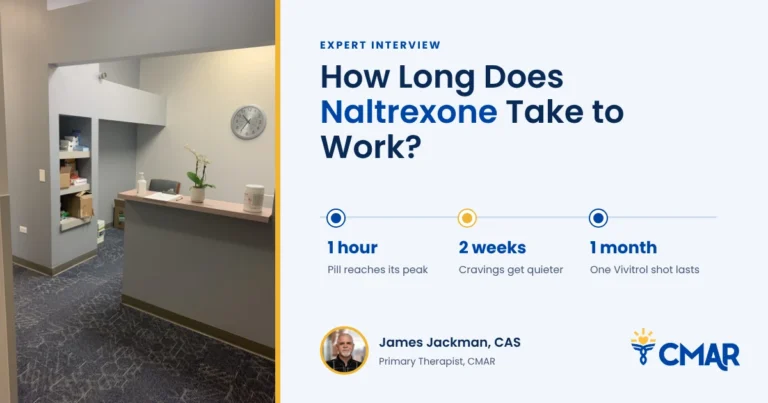
James says people notice “a moderate to significant decrease in craving.” Our guide on how long naltrexone takes to work covers the first weeks, and this one explains what happens if you drink on naltrexone.

q

Does MAT Work for Alcohol, or Only Opioids?

Yes, MAT works for alcohol as well as opioids. Naltrexone and Antabuse treat alcohol use disorder, and all three FDA-approved alcohol medications are nonaddictive, according to NIAAA. CMAR also uses comfort medications and controlled tapers for other substances, including benzodiazepines.

See how we use MAT for alcohol in Denver and MAT for opioids.

3
FDA-approved medications for alcohol use disorder, all nonaddictive
q

Suboxone, Vivitrol or Naltrexone: Which Is Right for Me?

It depends on the substance. Suboxone treats opioid use disorder. Naltrexone, as a daily pill or the monthly Vivitrol shot, treats alcohol use disorder and can also block opioids once you are off them. For alcohol, James calls naltrexone or Vivitrol the first line “for the overwhelming majority of patients.”

Timing matters too: Vivitrol requires being opioid-free for 7 to 10 days first (Vivitrol prescribing information), while buprenorphine can start during withdrawal. Choosing between two alcohol medications? Start with Vivitrol vs Antabuse.

q

How Long Do People Stay on Naltrexone or MAT?

There is no set end date. Some people stay on MAT for months and others for years, and your provider adjusts or tapers the medication as cravings settle and recovery steadies. If you are unsure, James suggests you “give it a try without committing to it long term.”

Make any change with your provider. Stopping buprenorphine suddenly can bring withdrawal back, which is why how MAT works at CMAR includes a planned taper. After stopping naltrexone or Vivitrol, opioid tolerance is lower, so using opioids carries a higher overdose risk.

q

Isn't MAT Just Trading One Addiction for Another?

No. Addiction is compulsive use that keeps causing harm, while MAT is a steady, prescribed dose managed by a provider. Naltrexone and Antabuse are not addictive at all, and James points out that these medications help people “show up and participate in their own lives and actually get better.”

Leaning on medication “doesn’t make you weak or less of a person,” he says. We go deeper on trading one addiction for another and how effective medication-assisted treatment is.

q

Can I Go to AA While on MAT?

Yes. You can take MAT and go to AA or other support groups at the same time. NIAAA notes that alcohol medications can be combined with behavioral treatment or mutual-support groups.

James sees room for medication, therapy and the 12 steps: “Whatever you believe, there is space for you to heal.”

q

Does Insurance Cover Vivitrol and MAT?

Most insurance plans cover MAT. CMAR works with Colorado Medicaid and is in network with plans such as Anthem BCBS, United and Optum, though coverage for a specific medication like Vivitrol depends on your plan.

Federal parity law helps: plans that cover substance use disorder treatment cannot set stricter limits than they do for medical care. The fastest way to know your costs is to verify your insurance, and Medicaid members can see our Medicaid-covered programs.

q

How Do I Get a Naltrexone Prescription or Start MAT in Denver?

Call CMAR, verify your insurance and complete a personalized assessment. After medical clearance, a CMAR provider can prescribe naltrexone or another MAT medication, often on the same day, and a therapist works with you from the start.

Our medical team is led by Medical Director Nathaniel Moore, MD. If you’re unsure, James would rather you ask than wait: “You really have nothing to lose by giving it a shot.” See how getting started at CMAR works or call (833) 448-0127.

CMAR treats alcohol and opioid use disorder in the Denver area with medication, therapy and groups, including PHP and IOP options and same-day starts.

Steve Sarin headshot
Marketing Director
A certified recovery coach who has written extensively about recovery and substance use disorder, Steve leads the expert interviews behind CMAR's articles.
In conversation with
CAS, Primary Therapist @ Colorado Medication Assisted Recovery
A Certified Addiction Specialist practicing in Colorado since 2015, James focuses on helping people recover a part of themselves they lost through addiction.
Ready to ask your own question?

VERIFY INSURANCE

Cortland Mathers-Suter

MSSA
Managing Partner

Cortland Mathers-Suter entered the treatment space after his own battle with addiction. He first worked as a peer mentor, before starting clinical work while completing his Masters of Science in social administration from Case Western Reserve University where he focused on policy and direct practice. Cortland moved to Colorado in 2015 to start his first addiction treatment program, AspenRidge Recovery. Under his tenure, AspenRidge Recovery became a two-location, nationally accredited organization. He has since spent the last two years researching and developing what is now Colorado Medication Assisted Recovery (CMAR).

According to Cortland, “Colorado Medication Assisted Recovery is the most important organization I have had the honor to help build. We’re offering a service that seeks to not only improve the lives of our patients but also evolve how we look at medication-assisted treatment in Colorado entirely. Most individuals receiving medication-assisted care only receive medication and urinalysis. Sure you can call that ‘treatment,’ but you can’t call that ‘recovery.’ Our model is about adding the missing recovery component, and thus affords an opportunity to achieve lasting change for each patient and the industry.”

Cortland and his treatment programs have received numerous honors. These include Colorado Business Magazine’s “GenXYZ” award, the 2020 “Titan 100” award, and his program AspenRidge Recovery was both a finalist for “Best Healthcare Company” and named in the “Company’s to Watch” by Colorado Business Magazine as well. He has been interviewed and quoted by numerous publications for his “addiction expertise”, including News Week, 5280 Magazine, the Denver Post, Elephant Journal, Colorado Biz Mag, and TheRecoverySource.org.

Tyler Whitman

Compliance/HR Administrator

Tyler is originally from Omaha, Nebraska. He worked in manufacturing administration for 18 years until he chose to pursue recovery from alcohol addiction, which led him to Chicago, Illinois. Since then, Tyler gained experience in retail, retail pharmacy, and healthcare as a vaccine coordinator for a local Colorado clinic. At the clinic, Tyler discovered that healthcare was the career change he had been looking for. His newfound passion for healthcare, combined with his lived experience with addiction, brought him to Colorado Medication Assisted Recovery as an Office Administrator.

In his free time, Tyler enjoys cooking, hiking, and skiing. He is currently pursuing a master’s degree in Health Services Administration from Regis University.

Simmeren Boanvala

BA
Outreach and Admissions Representative

Simmeren comes to CMAR after several years working admissions in inpatient psychiatry and addiction. A first-generation Colorado Native, Simmeren attended CU Boulder, where she earned a BA in psychology. Simmeren is currently completing her CAC III while working toward her master’s degree in marriage and family therapy.

According to Simmeren, “I joined CMAR because I believe in the quality and importance of the program whole-heartedly. My goal at CMAR is to guide each prospect who calls CMAR to find the best possible pathway to their recovery”. Simmeren currently lives in her hometown with her dog and cat.

Tyler Hale

Tyler Hale

Community Partnership Lead

Tyler Hale began his career in addiction treatment following a decades-long fight with his own substance abuse issues. Since achieving long-term recovery, Tyler has held various positions in direct care, client services, admissions and outreach departments at various addiction treatment organizations. From sober living program director to outreach director to admissions director at a drug and alcohol treatment program, Tyler consistently finds himself in leadership roles within the addiction treatment space.

Tyler is originally from Chicago, IL, where he graduated from Loyola University Chicago with a Bachelor of Arts in Sociology and Bioethics. Thereafter, Tyler built a successful career in the tech industry, before finding sobriety and a subsequent calling to help others. Tyler joined the team at CMAR because he believes in the efficacy of comprehensive and patient-centered outpatient treatment. In his free time Tyler enjoys camping, hiking and spending time with his newborn son.

Kirstin O’Carroll

MSW
Engagement and Relations Director

Kirstin O’Carroll started her career in addiction and mental health services 23 years ago after graduating with an MSW from The Oho State University. Hired directly from an internship program, she served as a case manager and vocational specialist on a community treatment team in Columbus, OH, working to help severely mentally ill adults remain at home and in a community setting. Within the same organization, she later transitioned to clinical assessment and crisis intervention services with children, adolescents, and adults. Through these experiences, she learned the importance of providing empathetic, high-quality care and the need to “start wherever the patient is” with regard to finding the best treatment & solutions for her patients.

After seven years, Kirstin made a career change to diagnostic sales and worked for several Fortune 500 companies as an acute care sales specialist. She is delighted to return “home” to her passion for helping others and believes her new role as community engagement coordinator for CMAR is the perfect alignment of both her clinical and sales skills. When not promoting CMAR, she can be found reading, running, hiking, watching movies, and spending time with her husband Dennis and senior canine son Reggie.

Thomas Mazzarella

LAC
Primary Therapist

Thomas is a Licensed Addiction Counselor (LAC) in the State of Colorado and a Licensed Addictions Specialist (LCAS) in the State of North Carolina with particular expertise in the treatment of chronic Substance Abuse Addiction and Dependency.

Thomas is dedicated to Individual, Couples, Family, and Group Counseling and Therapy for individuals with Substance Use and Mental Health issues and concerns.

James Jackman

CAS
Primary Therapist

James Jackman is a Certified Addiction Specialist and has been practicing addiction treatment in Colorado since 2015. James is pursuing his bachelor’s degree in psychology from Metropolitan State University Denver. James is a traditional CBT therapist specializing in childhood events that lead to adult addictions.

James has received special training in Family Systems, Inner Child, Maladaptive Schemas, and Adverse Childhood Experiences. James has worked in many treatment settings throughout his career and uses a client-centered treatment approach to help one recover from destructive patterns that facilitate addiction. In addition, James enjoys working with rescue animals and advocates for several local rescue organizations outside of work.

Megan Hanekom

LPC, LAC, NCC
Therapist & Clinical Compliance Officer

Megan is a licensed counselor who has worked in various mental health and addiction treatment environments. She practices cognitive behavioral therapy and motivational interviewing and believes in pulling from various therapeutic approaches to best support each individual. Megan received her bachelor’s in psychology and Spanish from Concordia College. She relocated from North Dakota to Colorado where she earned a master’s in counseling psychology from the University of Denver.

Outside of the office, Megan enjoys spending time with her two German Shepherds and her cat. She is passionate about fostering animals through various local rescues to find adoptive homes for dogs and cats in need.

Maggie Coyle

MA, LPC
Primary Therapist

Maggie Coyle, MS, MA, LPP, LPCC has worked in the mental health and addictions counseling field for the past six years. She has extensive experience in working in the varying levels of mental health and addictions treatment as well as with diverse populations.

She practices cognitive-behavioral therapy and dialectical behavior therapy as primary intervention methods. She has earned a bachelor’s degree in sociology as well as a master’s degree in clinical mental health counseling both from Northern State University in Aberdeen, SD. She has also earned a master’s degree in addictions counseling from the University of South Dakota in Vermillion, SD. Maggie moved from South Dakota to Colorado in June 2020 and is excited to be a part of the CMAR team.

Michael Damioli

LCSW, CSAT
Clinical Director

Michael Damioli has been passionately working in the fields of addiction treatment and mental health since 2012. He has held a variety of different roles within the addiction recovery space, ranging from peer support to direct clinical practice. Notably, Michael was part of a leadership group that developed a small therapy practice into a nationally branded addiction treatment program, which offers multiple levels of care to recovering professionals. Michael is a strong believer in the family disease model of addiction and has focused much of his clinical work and training on supporting families impacted by addiction. He also specializes in treating individuals suffering from co-occurring chemical and process addictions.

Michael is honored to be leading the clinical care team at CMAR and believes that excellent clinical care begins by simply treating a patient with dignity and respect. Michael is a strong advocate for ethical reform within the addiction treatment field and is excited to promote CMAR as an ethical and thought leader throughout the treatment & recovery industry. Michael earned his master’s degree in social work from the University of Denver and is independently licensed as a clinical social worker with the state of Colorado. He holds an advanced post-graduate certificate in marriage and family therapy from the Denver Family Institute as well as an advanced certificate in sexual addiction counseling from the International Institute of Trauma and Addiction Professionals.

Dwight-Duncan

Dwight Duncan

Psy.D
Psychologist

Dr. Duncan was born and spent most of his early life in California. He received his doctorate in clinical psychology from the University of Denver in 1987. He is a licensed psychologist as well as a licensed addiction counselor. He has had extensive training and experience throughout his professional career in medical psychology, mindfulness, integrated behavioral healthcare, and substance abuse.

Dr. Duncan is married and has one daughter, a neurologic physical therapist in Los Angeles.

Susan-Miget

Susan Miget

NP
Medical Provider

Susan has been in healthcare for more than 20 years. She was an ICU nurse for nine years, then returned to school and completed her master of nursing and family nurse practitioner degree at the University of Missouri-St. Louis in 2007. She practiced pain management for many years before developing her current passion for addiction treatment.

Susan has transitioned her practice to focus entirely on addiction treatment. She has worked in residential treatment, partial hospitalization (PHP), and intensive outpatient (IOP) programs. Susan most enjoys working with patients one-on-one in a private office to protect their confidentiality and ensure top-rate care. Knowing that addiction can affect anyone, anywhere, and at any time, Susan continues to strive to make treatment more accessible and confidential.

Whitney-Grant

Whitney Grant

MSN, FNP-BC, ARNP, RN, CPN
Medical Provider

Whitney Grant is an experienced family nurse practitioner with experience and expertise in medication-assisted treatment. Whitney earned her BSN at the University of Miami before moving on to achieve a master of science in nursing degree there as well, becoming a nurse practitioner immediately thereafter.

Whitney has since achieved board certification from the ANCC as a family nurse practitioner. After spending her entire formative and educational years in South Florida, Whitney moved to Denver in 2018 to pursue a career as a provider in family practice, sub-specializing in addictions medicine. Whitney has worked under the guidance of Dr. Nathaniel Moore, CMAR’s medical director, since moving to Denver.

Nathaniel Moore

MD
Medical Director

Dr. Nathan Moore is board-certified by the American Board of Family Medicine. Dr. Moore attended Stanford University in Palo Alto, CA for his undergraduate work and then attended Duke University School of Medicine and obtained his M.D. in 1995. Dr. Moore then came to Colorado and completed his residency in family medicine at the University of Colorado’s Family Medicine Program at Rose Medical Center.

Dr. Moore practices primarily at our Aurora location. He provides comprehensive family medicine services and has a special interest in addiction medicine, treating patients with opioid use disorder as well as alcohol addiction.

Dr. Moore is married with three children. He enjoys mountain biking, running, and golf.